Attic Insulation: Why It’s Often the #1 Renovation Priority
- Poorly insulated attics allow up to 30% of a home’s heat to escape, more than any other area (walls, windows, or floors).
- Heat rises naturally through convection: the roof is mechanically the primary thermal leak point in a house.
- The return on investment (ROI) is typically between 4 and 7 years, making it the most profitable project in any energy renovation.
- Insulating the attic before walls or windows prevents over-sizing other systems and wasting your available budget.
- Government grants and tax incentives significantly reduce out-of-pocket costs, making it even more worthwhile to start here.
If you were to undertake only one energy-efficient renovation this year, it should be attic insulation. The reason is as much physical as it is economic: a home’s heat naturally escapes through the top, and a poorly insulated roof can account for up to 30% of a building’s thermal loss, a figure frequently cited by energy agencies and industry professionals. Before upgrading windows, insulating walls, or installing a smart thermostat to fine-tune your heating, you must first stop the heat from leaking through the roof. This article explains the physics at play, why this project consistently tops renovation priorities, and how this step dictates the profitability of all subsequent work.
Why Heat Escapes Through the Roof First
The phenomenon is based on a simple physical principle: warm air is less dense than cold air, so it rises naturally through convection. In a heated home, this warm air accumulates under the ceiling—exactly where the attic is located. If this area is not properly insulated, the heat passes through the roofing and continuously dissipates outside, making it impossible for the heating system to compensate effectively.
This phenomenon is amplified by the surface area involved: in a standard detached home, the roof often represents the largest surface area for thermal exchange with the outside, even larger than the walls or window openings. A relatively small loss per square meter, when multiplied by a large surface area, results in a massive total loss.
To this, we add a frequently overlooked factor: uninsulated attics are directly exposed to outdoor temperature fluctuations without any thermal buffer. Unlike a wall, which may benefit from some level of insulation due to its composition (brick, plaster, etc.), an old roof often has no meaningful thermal barrier at all—especially in homes built before the late 1970s or 1980s, when insulation standards were virtually non-existent. It is this combination—convection physics, large surface area, and a frequent lack of original insulation—that makes the roof the structural “weak link” of a home’s thermal envelope and the first area that needs treatment.
The Real Impact of Heat Loss on Your Energy Bills
The 30% figure is not just a marketing slogan; it is a measurable reality for poorly insulated homes, particularly those where the attic has never been treated. In practical terms, this means that for every dollar (or euro) spent on heating, nearly a third literally goes up in smoke through the roof before it even has a chance to warm your living spaces.
This loss creates a cascade effect on the entire heating system. A boiler or heat pump must constantly work to compensate for this thermal leak, forcing it to run longer and more intensely to maintain the desired temperature. The result: premature equipment wear, higher-than-necessary energy consumption, and rising bills without any actual improvement in comfort. Even a precision-programmed smart thermostat cannot structurally compensate for a leak of this magnitude; it optimizes management, but it doesn’t plug the hole.
The reverse is equally true: once the attic is properly insulated, the drop in consumption is felt from the very first heating season—usually clearly and immediately—unlike other renovation projects where the effects may be more gradual or harder to perceive. This speed of results is what distinguishes attic insulation from other energy renovation tasks.
Why Start with the Attic Instead of Walls or Windows
In energy renovation, the order of operations matters almost as much as the quality of the work itself. Insulating walls or changing windows before treating the attic is like plugging secondary leaks while the main one remains wide open: the overall result will be disappointing, and the budget spent on those tasks won’t reach its full savings potential.
The hierarchy of renovation generally follows the magnitude of heat loss: roof first, then walls, then windows, then ventilation and floors. This hierarchy is not arbitrary; it reflects the relative impact of each area on a poorly insulated home’s total energy bill. Since the attic concentrates the largest share of losses, it logically offers the best ratio between investment and savings.
There is also a practical argument: attic work is often the fastest to complete and the least intrusive for occupants. For unfinished attics, the blown-in insulation technique (mineral wool or cellulose) can treat hundreds of square feet in a single day, without major disruption to the rest of the house. Compared to exterior wall insulation or full window replacement, it is an accessible project that delivers rapid comfort and savings gains before you even consider the next steps.
The Economic Calculation: A Fast-Return Investment
The cost of insulating an unfinished attic varies depending on the technique (blown-in vs. batt insulation), the thickness of the material, and accessibility, but it remains significantly lower than other major renovation items like exterior wall insulation or window replacement. This lower entry cost, combined with the scale of savings generated, explains why the ROI is so rapid: estimates generally converge on profitability being reached within 4 to 7 years, depending on the surface area, local climate, and the price of the energy used for heating.
This timeframe is short compared to other renovation investments, which can take ten to twenty years to pay off. It is driven by a particularly favorable ratio between the amount invested and the volume of annual savings on heating bills. In a 1,000 sq. ft. home with poorly insulated attics, the cumulative annual savings can amount to several hundred dollars, varying by energy type (electricity, gas, oil) and local climate.
Beyond just the heating bill, well-executed attic insulation also helps increase property value. An energy performance rating, which is increasingly scrutinized by buyers and required for sales or rentals, improves significantly after this type of work. A home that climbs one or more energy rating classes becomes more attractive on the market and can command a higher price—a powerful argument for owners considering a mid-term resale.
Unfinished vs. Finished Attics: The Priority Remains the Same
The distinction between unfinished attics (non-habitable, simple space under the roof) and finished/converted attics (transformed into living space) changes the insulation technique required, but it does not change the priority of the project. In both cases, this area of the house concentrates the most heat loss and must be treated first.
For unfinished attics, blown-in insulation on the floor is the most common solution: it is fast, economical, and involves spreading loose-fill material (glass wool, rock wool, or cellulose) directly onto the attic floor. For finished or convertible attics, insulation is done “under the rafters”—directly against the slope of the roof—usually with insulation panels or rolls complemented by a vapor barrier. This technique is more complex and expensive because it involves working in a space that is inhabited or intended to be, with more demanding finishing requirements (cladding, air gap ventilation).
In both configurations, the goal remains identical: interrupt the flow of heat escaping through the top of the building. The method adapts to the layout, but the priority does not change.
A Benefit That Extends Beyond Winter
Attic insulation is often associated only with the heating season, but its effect also works in the summer. The same physical mechanism that lets indoor heat leak out in winter works in reverse during the summer: without insulation under the roof, the heat accumulated by solar radiation on tiles or shingles propagates into the home. This makes converted attics nearly uninhabitable during heatwaves and warms the entire house as heat moves toward the lower floors.
Effective insulation acts as a double thermal barrier: it retains heat inside during winter and keeps it out during summer. This “summer comfort,” which is increasingly sought after due to the rise in heatwave frequency, provides an additional argument for prioritizing this project, even independent of heating savings.
This benefit naturally complements active thermal management solutions, such as ventilation or remote-controlled solar shading, which optimize air circulation but cannot combat a roof envelope that continuously lets heat pass through. Insulation constitutes the essential passive layer upon which regulation equipment should then rely.
Financial Incentives Reinforce the Priority Logic
The profitability of attic insulation is further improved by various financial assistance programs that reduce the out-of-pocket cost for households. Government grants, energy efficiency rebates, and reduced VAT/sales tax rates for energy renovation all apply to this type of project, provided you use an accredited professional contractor.
This accumulation of aid makes attic insulation one of the renovation items where the ratio between the actual amount spent by the owner and the gain obtained (savings + comfort + property value) is among the most advantageous on the market. For middle-income families, these incentives can cover a significant portion of the work cost, making the investment accessible even on a limited budget.
This financial dimension is not incidental to the hierarchy of work: with a constrained budget, it is better to concentrate available aid on the project that generates the most savings, rather than spreading it across several projects with diluted individual impacts. This is an extra argument, beyond building physics, for treating the attic before anything else.
Mistakes That Can Negate the Benefits of Insulation
Insulating your attic is not enough if the execution neglects essential technical details. The first common error concerns thermal bridges: untreated areas, often at the junctions between the floor and load-bearing walls, or around access hatches and chimney flues, which allow heat to slip through despite generally good insulation. An improperly treated thermal bridge can significantly reduce the efficiency of the entire project, even with high-quality insulation and sufficient thickness.
The second error involves ventilation. An attic insulated without sufficient airflow between the insulation and the roof covering can generate moisture problems, condensation, or even mold in the medium term, which degrades both the insulation’s performance and the roof structure. A ventilated air gap under the roof is not a minor detail; it is a requirement for the project’s durability.
Finally, the thickness of the insulation must be sufficient to reach the desired thermal performance. This requires referring to recommended thermal resistance (R-values) for the home’s specific climate zone rather than just making a default choice. A botched job in these areas can lead to disappointing real-world savings, even though the potential of attic insulation remains, in principle, the highest of all energy renovation tasks.
How much heat is actually lost through uninsulated attics?
Estimates generally converge around 30% of the total thermal loss in a poorly insulated home, a figure frequently cited by energy experts and industry professionals.
Should I insulate the attic before the walls or windows?
Yes, in the vast majority of cases. The attic concentrates the largest share of heat loss, making it a priority before investing in wall insulation or window replacement.
How long does it take for attic insulation to pay for itself?
The return on investment is typically between 4 and 7 years, depending on the surface area, the technique used, and the type of heating energy, making it one of the fastest-paying renovation projects.
Unfinished or finished attics: is the priority the same?
Yes. While the technique differs (blown-in for unfinished attics, rafter insulation for finished attics), in both cases, the roof remains the primary source of thermal loss.
Does attic insulation also improve summer comfort?
Yes. In addition to retaining heat in winter, high-performance insulation limits the entry of heat accumulated by the roof during summer heatwaves.
What financial aids are available for attic insulation?
Government grants, energy efficiency rebates, and reduced tax rates often apply to this type of work, provided you hire an accredited professional contractor.
What mistakes can reduce the effectiveness of attic insulation?
Untreated thermal bridges, insufficient roof ventilation, and undersized insulation thickness are the main causes of efficiency loss, even with high-quality materials.
Can a smart thermostat compensate for poorly insulated attics?
No. A smart thermostat optimizes heating management, but it cannot compensate for the structural thermal loss caused by an uninsulated roof.
Sources
- Attic insulation reduces heat loss by 30% (La Prime Energie)
- Attic insulation: techniques, price per m², and 2026 grants (Electricity Providers)
- Attic insulation for savings: a complete 2026 guide (Batirenov Pro)
- Is attic insulation a profitable investment? (Chantier Expert)
- Attic insulation aid: the complete 2026 list (Hello Watt)

D'autres conseils Energy-Efficient Renovation
 →
Wall Insulation: Interior vs. Exterior? Full Comparison
Compare interior (ITI) vs. exterior (ITE) wall insulation. Learn the pros, cons, costs, and how to choose the best option for your home renovation.
Lire l'article → →
Energy Renovation: Where to Start? A Complete Guide
Learn the essential steps for energy renovation: from diagnostics and grants to RGE professionals. A practical guide to optimizing your home improvements.
Lire l'article →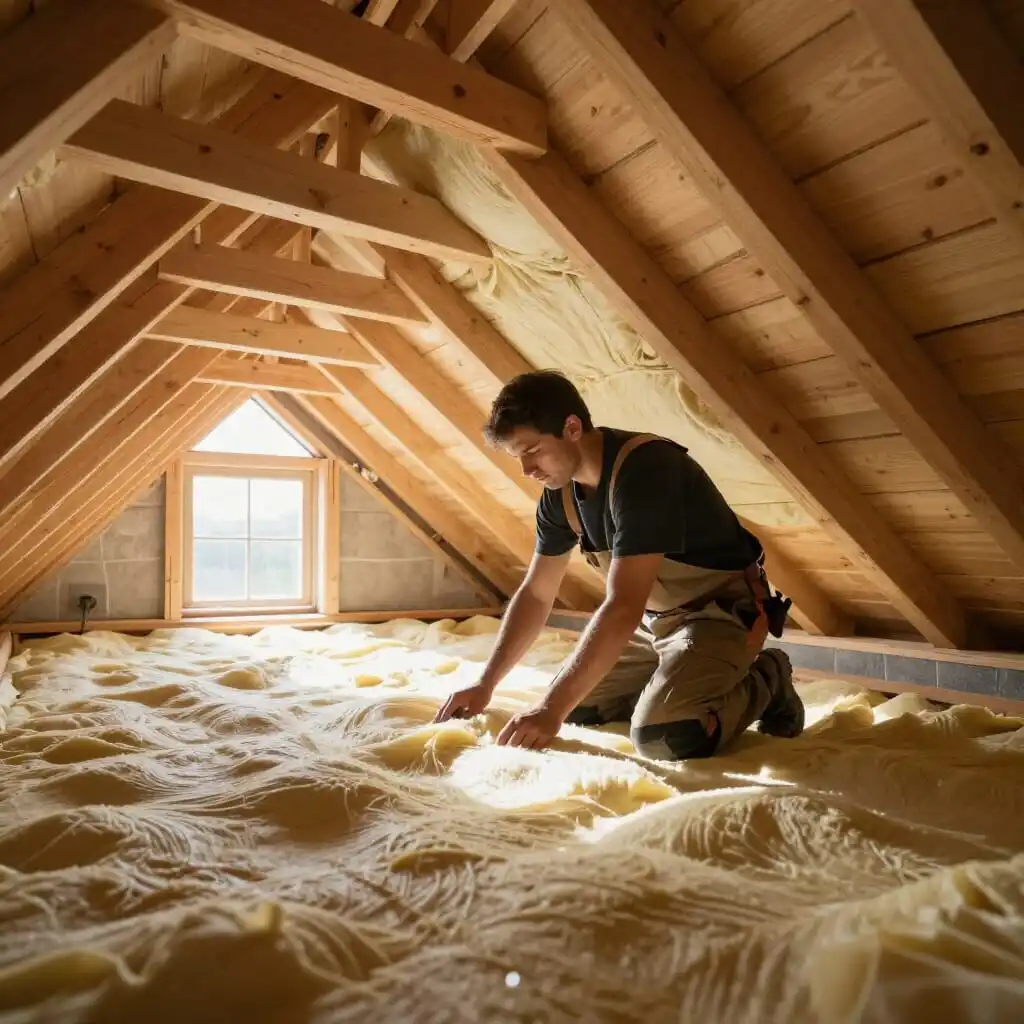 →
Attic Insulation: Why It’s Your #1 Renovation Priority
Learn why attic insulation is a top priority: up to 30% of heat escapes through the roof. 4-7 year ROI. Discover how to save…
Lire l'article → →
Window Replacement: Is It Worth the Investment in 2026?
Is replacing your windows worth it? Discover costs, energy savings, 2026 government subsidies, and the real ROI for your home improvement project.
Lire l'article →