
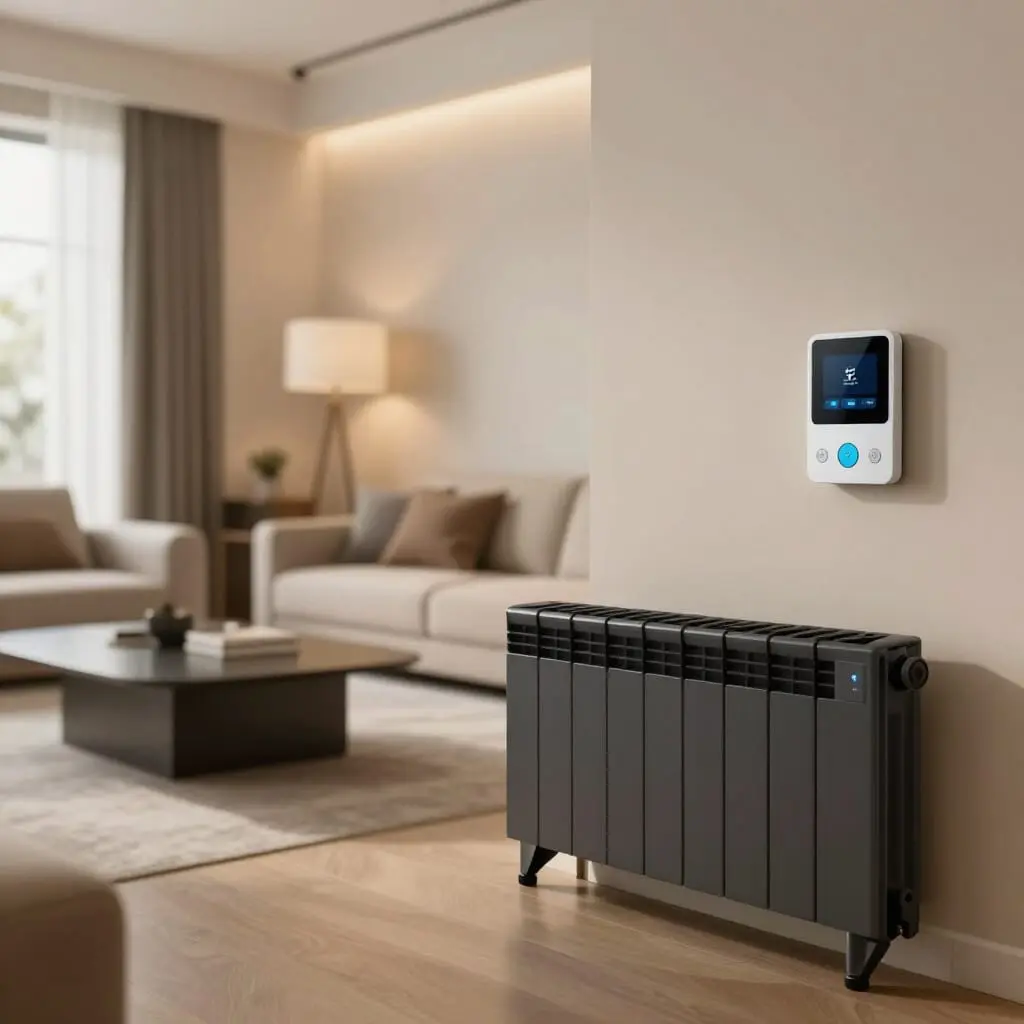
Electric Heating: How to Improve Its Performance?
- Heating accounts for 66% of the energy consumption in an electrically heated home: it is the primary lever for lowering your bills.
- Precise room-by-room control (smart thermostats, smart thermostatic valves, motion detection) can reduce heating consumption by up to 25% without major renovations.
- Regular maintenance (dusting, checking heating elements, keeping radiators clear) restores lost performance without needing to replace appliances.
- Remote management via a smart home hub allows you to adapt heating to actual occupancy schedules and off-peak electricity hours.
- Combining targeted insulation, appropriate settings, and smart home technology yields the best results, far beyond simply lowering the thermostat.
An electric heater that “consumes too much” is almost never due to a faulty device; more often than not, it is a problem of settings, management, and usage. Before considering an expensive replacement, there is a series of concrete actions—intelligent regulation, maintenance, daily habits, and smart home integration—capable of restoring much of the lost performance of an existing installation. Since heating accounts for nearly two-thirds of the energy bill in an electric home, this is where the most significant and fastest improvements can be made. This guide details, step by step, how to optimize an existing system without replacing radiators or undertaking major construction work.
Why electric heating performance declines over time
An electric radiator does not “age” in the same way a boiler does, but its actual performance often degrades without the user noticing. Three causes appear systematically.
The first is the lack of, or outdated, regulation. Many homes equipped ten or fifteen years ago still operate with radiators set to a fixed position, without precise electronic thermostats or hourly programming. The result is heating that runs at full capacity even when no one is present, or that overheats one room to compensate for the cold in another.
The second cause is dirt and obstruction. Dust accumulated on the grilles of a convection heater or a radiant panel reduces heat exchange and increases heating time. A radiator obscured by a curtain, a piece of furniture, or drying laundry will have its radiation absorbed instead of being diffused into the room—the device then consumes the same amount of energy for significantly less perceived comfort.
The third, less visible cause is the misalignment between installed power and the actual needs of the home. Partial insulation work (new windows, insulated attics) changes heat loss levels without the power settings or temperature thresholds being readjusted accordingly. A radiator can then become oversized, leading to short cycles and poor efficiency, or conversely, undersized in a room whose usage has changed (e.g., a home office or a child’s bedroom).
Understanding these causes allows you to target the most cost-effective actions: in most cases, it is not the heating power that is the problem, but how it is managed and utilized on a daily basis.
Optimizing room-by-room regulation
Regulation is the most profitable lever for improving the performance of existing electric heating, as it acts directly on the actual operating time of the appliances. Installing a centralized programmer compatible with existing radiators allows you to define different time slots for different rooms: comfort temperature in the living room in the evening, eco mode in the bedrooms during the day, and a total shut-off in unoccupied rooms.
Beyond simple hourly programming, smart thermostatic valves and room-specific regulation modules provide a level of precision that original mechanical thermostats cannot offer. They allow you to set a target temperature to within half a degree and vary it automatically according to a weekly schedule, avoiding the several-degree fluctuations typical of a simple rotary dial.
Motion detection is an interesting evolution for rooms with irregular occupancy, such as offices, teenagers’ bedrooms, or guest rooms. The radiator automatically switches to eco mode as soon as absence is detected, without manual intervention, and then resumes its comfort temperature just before the expected return.
One often neglected point: regulation must be consistent between rooms. Heating a bedroom to 19°C (66°F) while the adjacent hallway remains at 16°C (61°F) creates thermal transfers that skew measurements and force the bedroom radiator to compensate continuously. Harmonizing temperature differences between contiguous rooms—by following progressive guidelines (17°C in hallways, 19°C in living areas, 16-17°C in bedrooms at night)—limits these cross-losses and stabilizes overall consumption.
Strengthening targeted insulation without major work
Improving electric heating performance does not necessarily mean re-insulating the entire home. Targeted, quick, and inexpensive interventions are often enough to significantly reduce the heat loss that forces radiators to run longer.
Sealing windows and doors (window seals, door bottoms, roller shutter boxes) addresses one of the primary sources of cold air leaks in older homes. A simple foam or silicone seal applied to air entry points significantly reduces the draft felt near openings, which often allows you to lower the thermostat setting on the nearby radiator without losing comfort.
Radiator reflectors placed behind heaters located against an exterior wall reflect a portion of the radiation back into the room rather than letting it dissipate into the wall. This solution, particularly relevant in poorly insulated older buildings, is inexpensive and can be installed in minutes per radiator.
Keeping the space around appliances completely clear is a simple but often forgotten rule: leaving free space in front of and above a radiator, without furniture or curtains hanging in front of it, allows for homogeneous heat diffusion throughout the room instead of localized accumulation that forces the device to run longer to reach the same ambient temperature.
Finally, in homes where electric heating is paired with reinforced insulation (double glazing, insulated attics), the power of the initially installed radiators may become excessive. Readjusting power thresholds or selectively replacing mechanical thermostats with electronic models allows you to fully exploit these insulation gains rather than continuing to heat according to old settings.
Adopting the right thermal settings daily
Setting habits weigh as much as the technology installed. A reduction of just 1°C (1.8°F) in the overall thermostat setting of a home generally translates into a perceptible reduction in heating consumption, without a notable impact on comfort if applied progressively.
Differentiating by hourly usage is the most effective principle: comfort temperature only during actual periods of presence, and eco or frost-protection mode the rest of the time. A home occupied from 7:00 AM to 9:00 AM and then from 6:00 PM to 11:00 PM has no reason to be heated at the same temperature all day. Conversely, turning the heating off completely during the day in a poorly insulated home can force radiators to consume more energy during the restart to catch up on temperature—hence the benefit of an “eco mode” rather than a sudden shut-off.
Setting temperatures by room use prevents generalized overheating: a bedroom can be maintained very well at around 16-17°C (61-63°F) at night, a bathroom can temporarily rise to 20-22°C (68-72°F) during use and then drop, and a living room occupied in the evening justifies 19-20°C (66-68°F) without needing to maintain that setting all day.
Finally, staying vigilant about parasitic heat or cold sources prevents incorrect settings: a radiator located near an uninsulated window “thinks” it is heating correctly while the cold is constantly escaping, while a thermostat placed near a heat source (appliances, direct sunlight) may cut the heating prematurely. Correctly positioning temperature measurement elements is a simple check that is rarely performed.
Maintaining your installation to restore original performance
Regular, even basic, maintenance often restores a significant portion of an electric heater’s initial performance without any investment.
Dusting the grilles and heating elements, which should be done at least once a year before the heating season, improves the thermal exchange between the element and the ambient air. A dirty radiator takes longer to reach the target temperature, which extends its operating cycles for the same result.
Checking mounts and wall contact is particularly important for inertia heaters, whose heating core (cast iron, ceramic, or fluid) must diffuse heat homogeneously. An improperly mounted device, or one slightly pulled away from the wall, can lose part of its radiation to the rear instead of returning it to the room.
Checking thermostats and sensors is a frequently neglected step: an old mechanical thermostat may show a discrepancy of several degrees compared to the actual room temperature, skewing the entire regulation system. A simple thermometer placed at usage height in the room can verify this gap and, if necessary, allow you to recalibrate or replace the faulty regulation component.
Finally, for installations with electric underfloor heating, checking the condition of the heating cable and the sub-floor insulation is essential if you notice a drop in efficiency, as degraded insulation under the slab allows heat to leak downward instead of being returned upward into the room.
Managing heating remotely with smart home technology
Smart home solutions provide a level of control that manual settings cannot reach, especially for households with irregular schedules. A compatible smart home hub (via pilot wire modules, smart plugs, or smart thermostatic valves) centralizes the control of the entire home from a single app.
The main advantage lies in creating scenarios adapted to real lifestyles rather than a theoretical schedule: detecting prolonged absence via smartphone to automatically switch to eco mode, anticipating your return to restart the heating just before arrival, or automatic adjustments in case of extreme cold or warmth detected by an outdoor sensor.
Coupling your system with off-peak electricity hours allows you to concentrate part of the heating restart during the most advantageous tariff periods. This is particularly relevant for high-inertia radiators capable of storing heat for several hours. This approach does not reduce consumption in kWh, but it optimizes the cost.
Finally, real-time consumption monitoring, available on most smart hubs and connected programmers, offers continuous diagnostics: it allows you to immediately spot a radiator that is consuming abnormally more than others—a sign of a malfunction, a poor setting, or a localized insulation problem in that room. This feedback transforms heating management into a process of continuous adjustment rather than a fixed setting made once a year.
Common errors that cancel out performance gains
Certain widespread and often well-intentioned practices can reduce or cancel out the benefits of the optimizations you have put in place.
Using multiple space heaters to supplement an existing electric heating system (fan heaters, portable oil heaters) creates significant temporary overconsumption, often to compensate for a poorly adjusted primary setting rather than a real thermal need. It is almost always more efficient to correct the setting of the fixed installation than to add an energy-hungry mobile device.
Turning the heating off completely during short absences (a few hours) can be counterproductive for high-inertia radiators, which require more energy to restart than to maintain a reduced temperature. Using a “short absence” mode distinct from a “long absence” mode avoids this pitfall.
Neglecting ventilation in favor of a systematic fight against drafts can cost you in comfort and sometimes in indirect overconsumption: air that is too humid due to a lack of renewal creates a sensation of cold that prompts you to increase the thermostat, when the real problem lies in air quality rather than temperature.
Finally, setting the same temperature everywhere for convenience remains the most common error: it cancels the benefit of having individually controllable radiators and effectively treats a modern system like a basic installation without fine regulation.
What is the ideal temperature to optimize electric heating?
Generally recommended guidelines are approximately 19-20°C (66-68°F) in occupied living areas, 16-17°C (61-63°F) in bedrooms at night, and 17°C (63°F) in hallways. Every additional degree above these benchmarks significantly increases consumption without a proportional gain in comfort.
Should I turn off the electric heating during the day when I am out?
For a short absence of a few hours, an eco/reduced mode is more efficient than a total shut-off, especially with inertia heaters whose restart consumes more energy. For long absences (a full day or a weekend), a frost-protection or programmed eco mode is preferable to a complete cut-off.
Do inertia heaters really consume less than convection heaters?
An inertia heater does not consume fewer watts than a convection heater for the same installed power, but its more stable heat diffusion reduces the need to crank up the thermostat. This translates into real savings during use, often estimated between 25% and 45% depending on the associated insulation and regulation.
How can I tell if my electric heating is poorly set?
Perceived temperature differences between rooms, a radiator that runs continuously without ever reaching the displayed target temperature, or a sharp increase in your bill without a change in usage are priority signals to check with a thermometer placed in the room.
Can smart home technology really reduce my electric heating bill?
Yes, provided it is associated with realistic scenarios based on actual home occupancy. The gain comes mainly from reducing unnecessary heating time, rather than from “miracle technology”: without adjusting the scenarios, a smart hub provides no automatic benefit.
Does maintaining an electric radiator have a real impact on its performance?
Yes: a dirty radiator or one obscured by furniture takes longer to heat the room, which extends its operating cycles. Annual dusting and keeping clear space around the device are enough to restore much of the original efficiency.
Are off-peak hours useful for standard electric heating?
They are most useful for high-inertia devices capable of storing heat produced during off-peak hours and releasing it later. For simple convection heaters without storage capacity, the effect is more limited.
Sources
- Our tips for reducing your electricity bill – economie.gouv.fr
- Choosing heating programming solutions – Castorama
- Next-generation electric heaters: how to choose well in 2026 – Bâtiments et Énergie
- How to program an electric heater? – Thermor
- Reducing electricity consumption: the complete guide – Ootravaux

D'autres conseils Energy-Efficient Renovation
 →
Energy Renovation: Comfort, Savings & Home Value
Discover how energy renovation improves comfort, reduces bills, and boosts property value through insulation, heating, and smart upgrades.
Lire l'article → →
Best Heating Systems for Renovation: 2026 Comparison
Choosing a heating system for your renovation? Compare heat pumps, gas, wood, and electric options in our 2026 guide with practical expert advice.
Lire l'article → →
Energy Efficiency Renovation: What Actually Works
Discover the most effective energy renovation projects: insulation, heating, and ventilation. A complete guide to optimizing your home's energy consumption.
Lire l'article → →
Attic Insulation: Why It’s Your #1 Renovation Priority
Learn why attic insulation is a top priority: up to 30% of heat escapes through the roof. 4-7 year ROI. Discover how to save…
Lire l'article →