
Which Heating System to Choose for Home Renovation? The Complete 2026 Comparison
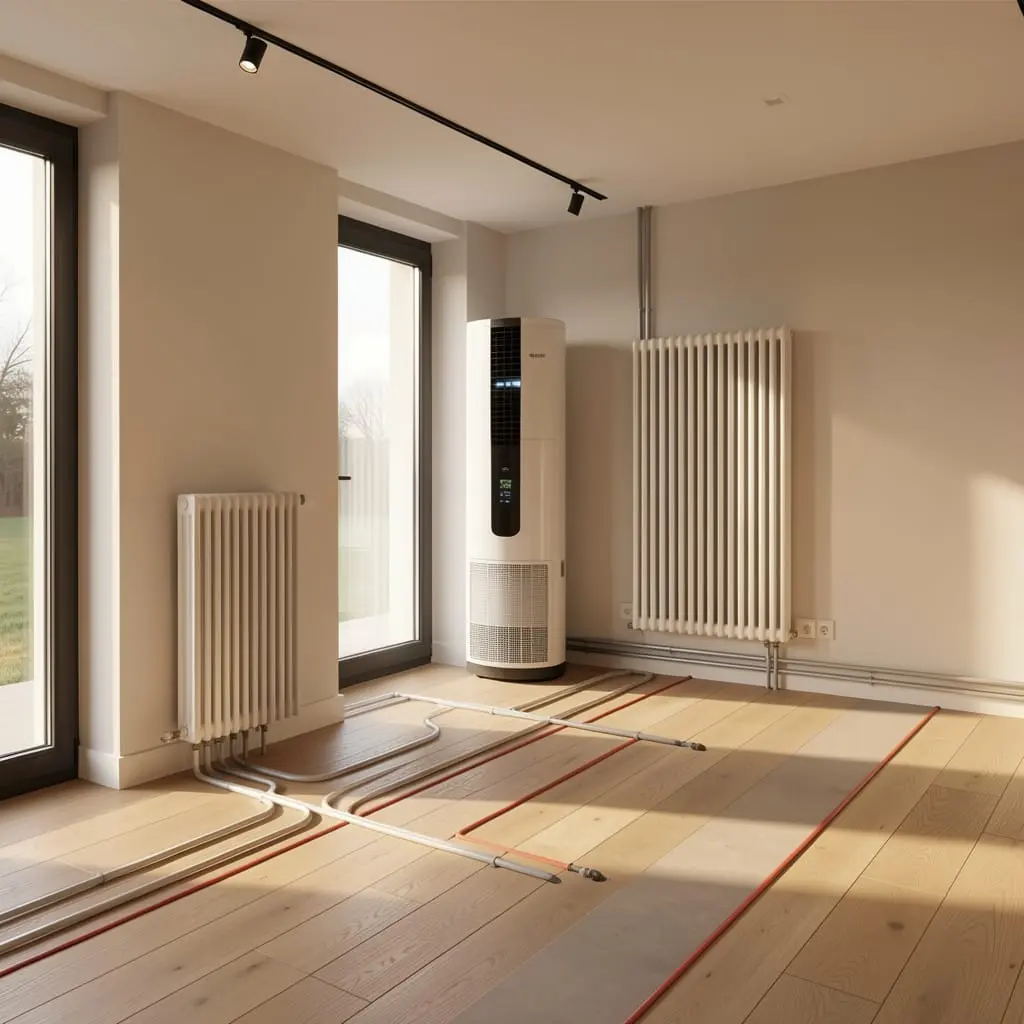
- Air-to-water heat pumps remain the most popular renovation solution, provided you have compatible low-temperature radiators or underfloor heating.
- Condensing gas boilers are still a viable option for upgrading existing networks, though their regulatory future is uncertain.
- Pellet stoves or wood boilers are attractive due to low running costs, though you must plan for fuel storage.
- Thermal inertia electric radiators are suitable for small, well-insulated spaces or as supplemental heating.
- The right choice depends primarily on your insulation quality, existing distribution network, and available budget before subsidies.
When choosing a heating system for a home renovation, you must first assess what is already in place: the radiator network, the quality of the insulation, and the available energy sources (natural gas, space for a tank, or access for an outdoor unit). For well-insulated homes with compatible emitters, the air-to-water heat pump (HP) has become the gold standard. Depending on 2026 subsidy scales, grants can reach €11,500 for air-to-water models and up to €19,000 for geothermal systems. However, in older, poorly insulated homes with small cast-iron radiators or a tight renovation budget, a condensing gas boiler, a pellet stove, or even low-consumption electric heating may be more realistic options. This guide details the selection criteria and compares available systems.
Key Criteria for Choosing the Right System During Renovation
Unlike new construction, where everything is designed from scratch, renovation requires working with what is already there. Three main factors will dictate your choice long before you consider specific brands or models.
The first is insulation quality. A poorly insulated home (uninsulated walls, uninsulated lofts, single glazing) has high heating demands and rapid heat loss. Installing a heat pump without addressing these losses first will severely degrade its performance and drive up your energy bills. In these cases, investing in partial insulation (lofts, floors) before upgrading your heating is often more cost-effective than simply over-sizing the heating unit.
The second criterion is your existing distribution network. Cast-iron or steel radiators designed for high-temperature operation (60-70°C) do not perform as efficiently with a heat pump, which is designed to deliver warmer water (35-45°C). You will then need to either replace the emitters with low-temperature models or fan heaters, or opt for a high-temperature heat pump, which carries a higher upfront cost.
The third factor is budgetary, but not just in terms of purchase price: you must compare the total cost of ownership over 10 to 15 years, including installation, annual maintenance, and energy costs. A gas boiler is cheaper to install but more expensive to run over the long term than a heat pump, whose Coefficient of Performance (COP) allows it to produce several kWh of heat for every 1 kWh of electricity consumed. Finally, technical access (space for an outdoor unit, natural gas connection, or wood storage) can restrict your options from the start, especially in apartments or dense urban areas.
Heat Pumps: The Most Popular Renovation Solution
An air-to-water heat pump extracts heat from the outside air to heat the water in your central heating circuit, directly replacing a boiler. This is currently the most recommended solution in most energy renovation guides, primarily because it allows homeowners to move away from fossil fuels while utilizing their existing radiator network or underfloor heating.
Its main advantage is efficiency: for every 1 kWh of electricity consumed, it returns an average of 3 to 4 kWh of heat. This translates into significant savings compared to gas or oil boilers—roughly 40% on annual heating bills according to professional comparisons. They are also eligible for substantial subsidies in 2026: up to €11,500 for air-to-water models and up to €19,000 for geothermal heat pumps (which are more expensive to install but offer more stable performance year-round).
However, there are limits. The initial investment remains high, often between €10,000 and €18,000 before subsidies for air-to-water models, with the ROI compared to a gas boiler generally estimated at around 7 years. Performance can also drop during extreme cold for standard air-to-water models, a factor to check based on your local climate. Additionally, an outdoor unit generates operating noise and requires an unobstructed location, which can be an issue in shared walls or apartment complexes. A hybrid heat pump, which combines a heat pump with a gas boiler for backup during extreme cold snaps, is an interesting alternative when the radiator network cannot be fully replaced.
Condensing Gas Boilers: A Relevant Choice, with Caveats
In a home already connected to the natural gas grid, replacing an old boiler with a condensing model remains a viable option, particularly when the renovation budget does not allow for a heat pump or when the high-temperature radiator network cannot be modified in the short term.
A condensing boiler recovers the latent heat contained in combustion fumes, improving efficiency compared to older standard boilers and reducing gas consumption by 15% to 20% for the same comfort level. Its installation cost, generally between €3,000 and €6,000, is significantly lower than a heat pump, and it can be installed quickly without modifying the existing network.
The main concerns are regulatory changes and gas prices. Government subsidies are now heavily focused on renewable solutions, and gas boilers alone are no longer eligible for programs like MaPrimeRénov’ in many cases, unless part of a larger, comprehensive renovation project. Furthermore, gas prices remain volatile and sensitive to geopolitical tensions, making long-term operating costs less predictable than with a heat pump. For a household planning to stay in their home for a long time, the choice is increasingly leaning toward a hybrid solution or a direct switch to a heat pump, unless faced with major technical or short-term budget constraints.
Wood or Pellet Heating: The Most Economical Option for Running Costs
Wood remains the cheapest heating energy per kWh, which explains the growing interest in pellet stoves and automatic wood boilers for renovations, especially in detached homes with storage space.
A pellet stove can heat a living area or, with an air or hydraulic distribution system, the entire home. A pellet boiler connects directly to your existing radiator network, much like a gas boiler, making it ideal for renovations where you want to keep your current emitters. Available subsidies in 2026 for this equipment can reach €3,400, significantly easing the installation budget.
The constraints are primarily practical. You need space to store pellets or logs, easy access for deliveries, and you must accept more frequent maintenance than a heat pump (emptying ash trays, mandatory annual chimney sweeping). Automatic wood boilers also require a larger storage silo, which limits them mostly to homes with a basement, garage, or dedicated technical room. In apartments or dense urban areas, this option quickly becomes unrealistic. For households with the necessary space, however, this is often the solution offering the best long-term running costs while remaining compatible with a classic central heating network.
Low-Consumption Electric Radiators: Simplicity and Low Upfront Cost
For renovations where you do not want to touch the hydraulic network, or in homes without a chimney or outdoor access, thermal inertia electric radiators remain a pragmatic solution. Their main advantage is ease of installation: no plumbing changes, no outdoor unit—just an electrical connection.
Inertia models (cast iron, ceramic, stone) diffuse a gentler, more stable heat than old-fashioned convectors. They also allow for room-by-room control, enabling precise temperature adjustments based on usage. This is a real asset for phased renovations, where each room can be equipped independently without waiting for the entire project to finish.
The main drawback is the cost of electricity per kWh, which is higher than wood and generally comparable to or higher than gas depending on the season. This makes the solution less ideal for poorly insulated homes with high heating demands. It is best suited for two profiles: small, well-insulated spaces where the bill remains manageable despite higher rates, and properties used as second homes or intermittently, where the low purchase price compensates for low usage. In a large, year-round occupied home, electric radiator heating alone is rarely the most economical long-term choice unless combined with reinforced insulation.
Hybrid Heating and Dual-Energy Solutions
Sitting between a standalone heat pump and a standalone gas boiler, a hybrid system combines both logics: a heat pump handles the heating for most of the year, while a gas boiler or an electric backup takes over during extreme cold snaps or when high power is temporarily needed.
This approach is highly beneficial during renovation because it allows you to limit the size (and therefore the cost) of the heat pump while guaranteeing comfort during deep freezes, without needing to over-size the unit for just a few days of winter. It is particularly suited for homes already connected to gas, where you want to reduce fossil fuel consumption without completely removing the existing boiler, especially if a full radiator replacement isn’t planned soon.
The compromise is complexity: you have two systems to maintain, more sophisticated controls to set up, and an initial investment that remains higher than a gas boiler alone. It is more of a transition option than a permanent one, often chosen by households planning to complete their energy renovation (insulation, radiator upgrades) in multiple phases to avoid doing the heating work twice. Once insulation and emitters are upgraded, switching to a standalone heat pump usually becomes possible and more profitable.
Budget and Financial Aid: What Really Drives the Decision
The sticker price of a heating system never reflects the real cost after subsidies, and this gap can completely flip your decision-making process. In 2026, government grants (such as MaPrimeRénov’ in France), energy savings certificates (CEE), and zero-interest eco-loans constitute the three pillars of financing, with amounts varying significantly based on household income and the equipment chosen.
For an air-to-water heat pump, combined aid can reach €11,500, and up to €19,000 for geothermal models, which drastically reduces the net cost compared to the catalog price. For a pellet stove or boiler, the aid package is closer to €3,400. These amounts sometimes bring the final cost of a heat pump close to that of a standard gas boiler, explaining the massive shift toward renewable solutions in recent years.
However, you must think in terms of total cost, not just the amount of aid. A system that receives less aid but is cheaper to buy may remain more advantageous if the home is small or already very well insulated. Conversely, in a large older home, the performance gap between systems widens quickly on the annual bill, often justifying the higher initial investment of a heat pump, even after subsidies. Conducting an energy audit before deciding can provide an objective calculation rather than relying solely on installation prices.
How to Decide Based on Your Property Profile
Beyond generic comparisons, the best heating depends on your home’s specific configuration. A house from the 1970s-1990s with decent insulation and recent radiators is a great candidate for a direct air-to-water heat pump without heavy additional work. An old stone house with poor insulation and small cast-iron radiators will benefit more from prioritizing insulation first and considering a condensing boiler or a hybrid system in the meantime, rather than an underperforming heat pump.
For a home connected to the gas grid with a limited renovation budget, replacing an old boiler with a condensing model remains a reasonable short-term option, while planning a switch to a heat pump during a future renovation cycle. For a home with storage space and easy delivery access, wood or pellets offer the best running costs, provided you accept the more frequent maintenance required.
Finally, for an apartment or a small, well-insulated space where installing an outdoor unit or a storage silo is impossible, thermal inertia electric radiators often remain the only realistic option—especially in apartment buildings where technical and administrative constraints limit alternatives. In all cases, getting multiple quotes from certified professionals (such as RGE-certified installers in France) is essential to receive subsidies and to compare concrete proposals rather than theoretical averages.
Which heating should I choose for an old house renovation?
In an older, poorly insulated house, it is better to prioritize insulation before choosing a system. Then, consider a condensing boiler or a hybrid heat pump if the radiators cannot be replaced immediately.
Does a heat pump work with existing radiators?
It depends on their operating temperature: low-temperature radiators or underfloor heating work well, while high-temperature cast-iron radiators reduce efficiency and may require a high-temperature heat pump or an upgrade to the emitters.
What is the most economical heating for a renovation?
Wood and pellets offer the lowest running costs, followed by heat pumps due to their high efficiency; gas and electric radiators are generally more expensive to run over the long term.
Can I keep a gas boiler during an energy renovation?
Yes, technically, but financial aid is now heavily focused on renewable solutions, making a standalone gas boiler less financially attractive than a heat pump or a hybrid system in the long run.
What subsidies are available for changing heating in 2026?
Main programs include MaPrimeRénov’, energy savings certificates (CEE), and zero-interest eco-loans, with amounts potentially reaching €11,500 for air-to-water heat pumps and up to €19,000 for geothermal models, depending on income.
Should I insulate before changing my heating?
Yes, whenever possible. Insufficient insulation significantly reduces the performance of systems like heat pumps and increases heating demands, regardless of the equipment installed.
What heating should I choose for an apartment renovation?
Thermal inertia electric radiators are often the most realistic solution in apartments due to the lack of space for an outdoor heat pump unit or wood storage, unless there is a collective central heating project in the building.
How much does it cost to replace a heating system during renovation?
The budget varies greatly by technology: approximately €3,000 to €6,000 for a condensing gas boiler, compared to €10,000 to €18,000 before subsidies for an air-to-water heat pump.
Sources
- 2026 Heating Change Grants – Complete Subsidy Guide (France Artisan)
- Heat pump or gas boiler? Complete Guide 2026 (Pirrotta)

D'autres conseils Energy-Efficient Renovation
 →
Home Renovation Financing: 2026 Grants and Loans
Learn how to fund your home renovations. From government grants and eco-loans to condo financing: the complete guide to managing your budget.
Lire l'article → →
Stop Heat Loss: A Complete Guide to Home Insulation
Learn how to reduce heat loss in your home. From roofs and walls to windows: find effective and cost-efficient insulation solutions.
Lire l'article → →
Energy Renovation: Where to Start? A Complete Guide
Learn the essential steps for energy renovation: from diagnostics and grants to RGE professionals. A practical guide to optimizing your home improvements.
Lire l'article → →
Energy Renovation for Old Houses: Where to Start?
A complete guide to starting your old house energy renovation. From energy audits to electrical safety and insulation, learn the key steps to prioritize.
Lire l'article →