
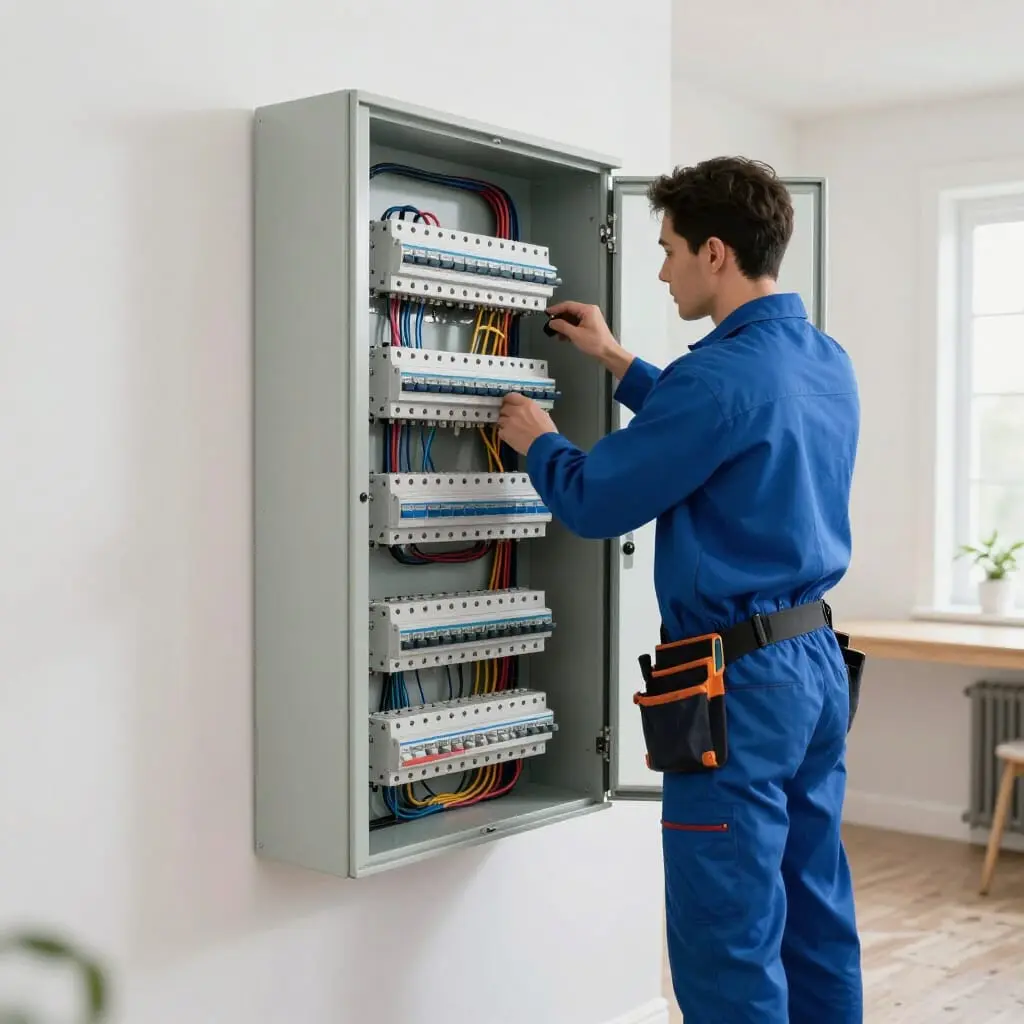
Replacing Your Electrical Panel: When Should You Act?
- Porcelain fuse boards or panels older than 20 years are considered obsolete and should be prioritized for replacement.
- Repeated circuit tripping, a burning smell, or heat marks around the panel require immediate professional intervention.
- The absence of a 30 mA RCD (Residual Current Device) increases the risk of electrocution and no longer complies with the NF C 15-100 standard.
- While upgrading to current standards is only legally mandatory during a sale, rental, or major renovation, it is highly recommended as soon as any danger signs appear.
- Expect to pay between €450 and €2,300 (including installation), depending on the size of the home and the condition of the existing setup.
An electrical panel doesn’t always give warning before failing, but it almost always sends signals before becoming dangerous. You can decide whether to intervene based on three main criteria: the age and technology of the panel (fuses, lack of RCDs), daily symptoms (frequent tripping, overheating, smells), and regulatory context (sale, rental, or renovation work). If any of these signals are present, intervention is no longer a matter of comfort, but of safety. This guide details every scenario to help you determine if a simple safety upgrade is enough or if a complete replacement is necessary.
Visual Signs That Leave No Doubt
Some clues are visible and even detectable before you even open the panel door. A persistent burning plastic smell near the enclosure, even if faint, signals abnormal overheating of a connector or a live wire: this phenomenon often precedes an electrical fire and justifies cutting the power until a professional arrives. Blackening or melting marks around a circuit breaker or a fuse holder indicate that a contact point has heated beyond its limit, usually due to a loose connection or a rating that is unsuitable for the circuit’s load.
The presence of screw-in porcelain fuses (the famous “cartridges”) rather than modern modular circuit breakers is a major red flag on its own. This technology, common before the 1990s, does not cut power as quickly as a modern breaker and offers no integrated differential protection. A panel that mixes several generations of equipment, with visible additions made “over the years” (exposed terminal blocks, wires protruding from the box, overcrowded rows), reveals an installation that has evolved haphazardly without a cohesive plan, meaning its overall reliability can no longer be guaranteed.
Finally, a panel that is too small for the number of circuits it serves—recognizable by cramped wiring or makeshift additional rows—will prevent any clean expansion (such as adding an EV charger, a heat pump, or smart home automation) without a complete overhaul.
Repeated Tripping: Understanding the Warning Signs
A circuit breaker that trips occasionally—for example, when simultaneously starting an oven and a dryer—is simply functioning as intended. However, frequent tripping without an identifiable cause, occurring several times a week or during routine tasks (turning on a lamp, plugging in a charger), almost always indicates an underlying fault: a current leak in a circuit, a worn-out RCD that trips too early, or a chronic overload on an undersized circuit.
The mechanism is simple: an RCD constantly measures the difference between the current entering and leaving a circuit. If the difference exceeds a set threshold (30 mA for personal protection), it trips the power. When this discrepancy exists constantly at a level near the threshold—due to moisture in an outdoor conduit or a slightly defective appliance—the tripping becomes random and repetitive. Ignoring this symptom by simply resetting the breaker is essentially masking an insulation fault that could eventually escalate into a short circuit or a fire.
A panel that trips the entire installation (the main breaker) rather than a single circuit should be even more alarming: this often means the leak is upstream, in the panel’s own wiring or at the meter connection, an area that requires a qualified professional rather than a simple reset.
The Age of the Panel: A Decisive Factor
Beyond visible symptoms, the age of the panel remains the most reliable indicator for anticipating failure or danger. A panel installed more than 20 years ago was designed in an era when electrical safety standards were significantly less demanding. These older systems often lack widespread 30 mA RCD protection, feature undersized circuits for today’s electrical loads (the proliferation of electronic devices, EV charging), and use materials (insulators, contacts) that lose reliability over time due to repeated heating cycles.
After about fifteen years without an update, a panel is highly likely to fall short of current requirements, even if it still appears to function without issue. This wear is progressive and invisible: internal contacts oxidize, tripping mechanisms lose responsiveness, and the resistance of certain components increases slightly, generating more heat for the same amount of current. A panel doesn’t just “break” suddenly; it loses its safety margin year after year.
This age criterion is especially relevant when buying an older property: a panel that hasn’t been modified since the house was built, especially if it dates before 1990, should systematically be inspected by a professional before moving in, regardless of how it looks on the outside.
The Absence of RCD Protection: The Number One Risk
The 30 mA RCD (Residual Current Device) is the component that directly protects people from electrocution by cutting the power in a fraction of a second as soon as an insulation fault is detected in an appliance or socket. A panel lacking this protection, or only having it on some circuits, exposes occupants to a risk of electrocution if they come into contact with a faulty appliance—a situation that remains one of the leading causes of domestic electrical accidents.
This defect is easy to spot: on a modern panel, every group of circuits (row) must be preceded by a dedicated RCD. If the panel only has a single RCD for the entire installation, or none at all, the protection is insufficient by today’s standards. Similarly, the absence of grounding (earthing) on certain circuits, common in older homes that have never been renovated, exacerbates this risk because the RCD cannot function correctly without a continuous ground path.
This point requires particular vigilance in wet rooms (bathrooms, kitchens, outdoor areas), where the human body offers lower electrical resistance, making the risk of serious electrocution much higher in the event of an undetected fault.
What the NF C 15-100 Standard Actually Says
The NF C 15-100 standard governs the design of low-voltage electrical installations in France: it dictates the panel’s location, accessibility height, number of rows, the presence of RCDs per circuit group, and spare capacity for future upgrades. It defines what a compliant installation looks like, but its retroactive application follows a specific logic that is important to understand to avoid misunderstanding your obligations.
An existing installation is not required to meet current standards overnight: the standard applies fully to new constructions and total renovations. For an old home that is occupied without planned works, regulations only require a minimal safety upgrade (the presence of a main connection breaker, at least one 30 mA RCD, a grounding connection, and overcurrent protection for every circuit), which is a much narrower requirement than full NF C 15-100 compliance.
However, upgrading becomes mandatory in three specific situations: during a sale, where an electrical diagnostic is required for installations older than 15 years (the diagnostic informs the buyer of risks but doesn’t strictly force the seller to upgrade); during a rental, where the landlord must guarantee a decent home according to the law, which includes a safe electrical installation; and during major renovations affecting the panel or circuits, which must then comply with the current version of the standard.
Full Renovation or Targeted Safety Upgrade?
When faced with a problematic panel, two approaches exist, and the choice depends entirely on the nature of the detected signals. A targeted safety upgrade consists of adding missing protections without replacing everything: installing a missing 30 mA RCD, replacing a faulty breaker, or adding a ground connection to a circuit that lacked one. This approach is suitable when the panel itself is structurally sound, has free rows available, and only one or two specific elements are problematic.
On the other hand, a full replacement is necessary as soon as multiple signals accumulate: a fuse-based panel, a widespread lack of RCDs, a saturated enclosure with no room for growth, or heat marks indicating global equipment fatigue. In this case, fixing things point by point is like repairing an obsolete structure; you risk having to redo the work again shortly. A new panel also provides a frequently underestimated advantage: spare rows and modules, which are essential for integrating an EV charger, a heat pump, or smart home devices in the coming years without another renovation.
A professional diagnosis by an electrician allows for an objective decision: they will evaluate the state of the wiring upstream of the panel (often the limiting factor, as a new panel on old wiring doesn’t eliminate all risks), the number of existing circuits, and their individual compliance, before recommending the best option for your budget and your home’s needs.
The Real Risks of Leaving a Panel as Is
Delaying intervention on a panel that shows danger signs is not just a choice to defer comfort; it is continuous exposure to three types of risks. The fire risk comes from a contact point or a wire that progressively heats up without being detected until it reaches the ignition temperature of surrounding materials (insulation, dust, wood); electrical installations are among the leading causes of domestic fires. The electrocution risk directly affects occupants if an insulation fault is not intercepted by a missing or poorly calibrated RCD, with consequences ranging from a simple shock to a serious accident depending on the intensity and duration of contact.
The third risk, less immediate but very real, concerns home insurance. In the event of a claim related to an electrical installation that is clearly poorly maintained or non-compliant (for example, a fire traced back to an outdated panel that was never updated despite documented warning signs), the insurer may cite a lack of maintenance to reduce or refuse compensation, depending on the contract clauses. This underscores the importance of having a professional inspect the panel as soon as a signal appears, if only to have a written diagnostic in case of future disputes.
Budget and Process of an Intervention
The cost of replacing an electrical panel varies mainly based on three factors: the size of the home (number of circuits to connect), the condition of the existing upstream wiring (partially replacing lines increases the bill), and the quality level of the chosen equipment. For a full replacement including installation, the budget most often falls between €450 and €2,300 (including tax), with the lower end corresponding to a small home with healthy wiring and the higher end to a larger house requiring partial circuit updates. A targeted safety upgrade (adding an RCD, replacing a few breakers) is significantly cheaper, generally between €150 and €500 depending on the number of elements involved.
A typical intervention begins with an on-site diagnosis: the electrician identifies the number of circuits, their condition, and the presence or absence of grounding and RCDs before providing a detailed quote. This is followed by the removal of the old panel (partially if some elements are kept, totally if not), followed by the wiring of the new enclosure and the connection of each circuit. The intervention concludes with compliance testing (tripping the RCDs, checking ground continuity) before being put back into service—a step that must never be skipped, as it is the only way to guarantee that the new protections actually work.
Why You Should Hire a Professional Instead of DIY
Working on an electrical panel means working in direct proximity to the main power supply, upstream of any RCD that would protect an untrained individual. This specific danger justifies systematically entrusting the diagnosis and the work to a qualified electrician, who is capable of identifying the root causes of a symptom (recurring tripping might stem from a faulty appliance, a damaged cable in a wall, or the RCD itself) rather than simply replacing the visible part.
A serious diagnosis always begins with a complete visual inspection of the panel and accessible circuits, followed by measurements (ground resistance, RCD trip tests) that objectively assess the real state of the installation beyond appearances. Requesting multiple quotes remains wise, provided you verify that each proposal details the exact scope of work (panel only, or upstream circuit work), as two quotes with very different amounts might actually cover incomparable services. Finally, a certificate of compliance, issued after inspection by an authorized body (such as Consuel in France) during a full replacement, provides formal guarantee that the installation meets current safety requirements.
What is the cost to replace an electrical panel?
Expect between €450 and €2,300 (including tax) for a full replacement, depending on the size of the home and the state of the existing wiring. A simple safety upgrade (adding an RCD, a few breakers) generally costs between €150 and €500.
Is changing the electrical panel mandatory?
No, except during a sale (mandatory diagnostic for installations over 15 years old), a rental (decency obligation), or major renovation work affecting the panel. Outside of these cases, only a minimal safety upgrade is required by regulation.
How long does an electrical panel last?
A well-maintained panel can function for 20 to 30 years, but its reliability and compliance degrade much sooner, especially once RCD protection is missing or if the equipment has remained unchanged since the 1990s.
Can I change my electrical panel myself?
It is not recommended: the work is done in direct proximity to the main power supply, without RCD protection upstream, and a wiring error can make the installation dangerous despite using new equipment. A qualified electrician also guarantees the necessary compliance for insurance and, in the case of a sale, for certification bodies like Consuel.
What are the signs of a dangerous electrical panel?
Screw-in fuses, a burning plastic smell, blackening marks, repeated tripping without an apparent cause, the absence of a 30 mA RCD, and an enclosure overcrowded with wires added over time are the most frequent signals.
Should I replace the whole panel or just part of it?
A targeted safety upgrade is sufficient if the panel is structurally sound and only one or two elements are missing. A full replacement is necessary when multiple signals accumulate (fuses, saturation, widespread lack of RCDs).
Is the electrical panel covered by home insurance?
Damage related to an electrical fault is generally covered, but an insurer may reduce compensation in the event of a claim if they establish a clear lack of maintenance on an outdated installation that was never updated despite known danger signs.
Sources
- When should you change your electrical panel? — Prix-elec.com
- Changing your electrical panel: price, installation, standards — IZI by EDF
- Electrical panel compliance: is it mandatory? — IZI by EDF
- Price of an electrical panel change in 2026 — Prix-travaux-m2.com
- NF C 15-100 standard: the guide — Legrand
- When should you replace your electrical panel? — En-renovation.fr

D'autres conseils Electrical Systems & Smart Home
 →
Smart Home Installation: Avoid These Mistakes for Success
Avoid common smart home installation errors: protocols, Wi-Fi, ecosystems, and security. A complete guide for a successful project.
Lire l'article → →
Smart Home Energy Savings: What Actually Works
Discover which smart home solutions truly reduce your energy bills. We analyze smart thermostats, plugs, and more for real savings and ROI.
Lire l'article → →
Smart Home: Wi-Fi, Zigbee, or Matter? Comparison Guide
Compare Wi-Fi, Zigbee, and Matter for your smart home. A complete guide to choosing the right protocol based on your budget and device needs.
Lire l'article → →
Smart Home Guide: How to Fully Automate Your House
Learn how to build a truly smart home: protocols, automation tips, budget, and essential gadgets to get started the right way.
Lire l'article →