
Smart Heating: More Comfort and Lower Bills Every Day
- Heating accounts for 60% to 70% of a home’s energy consumption, making it the most effective area for smart home savings.
- Field studies show 12% to 18% annual savings with a well-tuned smart system, roughly $250 to $600 per year for an average home.
- Industry experts estimate a 5% to 15% saving for standard programmable thermostats, which can jump to 25-30% with the most advanced AI models.
- Comfort improves alongside the budget: room-by-room regulation, weather anticipation, and occupancy detection eliminate temperature swings.
- As many government subsidies for smart controls phase out, the decision now rests on the equipment’s own ROI (Return on Investment).
For the average household, heating represents the lion’s share of the energy budget. This is where the real savings happen—long before you look at other smart gadgets. A smart heating system—consisting of smart thermostats, controllable radiators, or smart thermostatic valves (TRVs)—allows you to manage temperatures room by room, anticipate your schedule, and cut the heat exactly when needed rather than letting it run constantly. Real-world data suggests savings between 12% and 18% on annual bills. Beyond the numbers, the real shift is in comfort: no more forgetting to turn off the heat, no more freezing rooms upon waking up, and warmth that arrives exactly when you need it.
Thermal Comfort: The First Benefit You’ll Feel
Before diving into the numbers, it’s important to understand how smart heating actually changes your daily life. With traditional heating, the logic is binary: you turn the wall thermostat up or down, often by guesswork, leading to huge swings between a cold morning wake-up and an overheated house while you’re at work. Smart heating flips this logic by anticipating your needs.
Specifically, smart thermostats and TRVs learn the “thermal inertia” of your home. They calculate how long it takes to heat a room from a certain temperature and trigger the heating early enough to reach your target temperature exactly when your alarm goes off. This is known as “optimal start,” a feature now standard on most high-end smart thermostats.
The second major comfort boost is room-by-room regulation. Traditional systems often impose a single temperature for the entire house, even though needs differ: a cooler bedroom for better sleep, a warmer living room for the evening, and a bathroom heated only in the morning. Smart valves installed on water radiators or connected electric heaters allow you to adjust these zones without walking from room to room turning dials. This personalized comfort is often cited by users as the most immediate benefit, even before they see the impact on their bills.
Finally, remote control changes the commute. There’s no longer a need to leave the heat running all day “just in case” you get home early; you can simply trigger the warmth from your smartphone once you’re on your way.
Measured Savings, Not Just Promises
While manufacturer claims can be optimistic, independent data points toward a credible range. Energy efficiency studies place the savings from a programmable thermostat between 5% and 15%, depending on actual usage—a figure that depends more on the household’s habits than the technology itself. A UK-based study by energy professionals measured up to 12% savings among households that actively configured their schedules, reminding us that the device alone does nothing; the settings produce the results.
In residential smart home installations monitored between 2024 and 2025, measured savings rose to an average of 12-18%, roughly $250 to $600 per year for a standard home heated by electricity or gas. The most advanced systems—combining habit learning, occupancy detection, and weather forecasts—can push this figure to 25-30% in ideal conditions: well-insulated homes, residents with regular schedules, and multiple distinct heating zones.
These differences aren’t about the brand, but three cumulative levers: reducing temperature during absences (every degree lower represents roughly 7% less consumption), stopping the heat early before bedtime by leveraging the home’s thermal mass, and eliminating wasted heat in rarely used rooms. Smart heating doesn’t rewrite the laws of physics; it simply automates best practices that few people have the time or attention to apply manually every day.
Accessible Equipment to Get Started
You don’t need to overhaul your entire heating system to go smart. Three main types of equipment exist, with varying levels of investment and complexity.
The Smart Thermostat is the most common entry point for central heating (gas, oil, or heat pumps). It replaces your existing ambient thermostat and controls the boiler or heat pump via a single temperature sensor. It offers the best simplicity-to-savings ratio for homes with uniform heating.
Smart Thermostatic Radiator Valves (TRVs) are installed directly onto each water radiator, replacing the traditional manual valve. They allow for fine-tuned, room-by-room regulation without touching the rest of the system, making them the best choice for homes where temperature needs vary wildly from one room to another.
Smart Electric Radiators are designed for homes with direct electric heating. These integrate their own intelligence (window-open detection, scheduling, remote control) without needing a separate central hub.
In all three cases, installation generally requires no major construction. These devices are designed as direct replacements for existing hardware, connecting via Wi-Fi or dedicated radio protocols (such as Zigbee). The budget varies based on the solution and the number of rooms; a full home setup requires multiple units if you want complete room-by-room regulation.
Smart Programming: Distinguishing Tools from Gadgets
Not all smart solutions are equal. The difference isn’t in the app’s design, but in three specific functions that determine the actual impact on your bill and comfort.
Presence and Absence Detection is the most profitable feature. A system that automatically identifies when the home is empty (via smartphone geolocation, motion sensors, or habit analysis) can lower the target temperature without manual intervention, preventing the “forgotten” heat from running during an unplanned work-from-home day or a weekend trip.
Outdoor Weather Integration allows the system to adjust its heating anticipation. A freezing day requires an earlier start than a mild day to reach the same temperature by the desired time; conversely, it prevents overheating when the weather is pleasant.
Open-Window Detection, available on most recent smart radiators and valves, automatically cuts the heat during ventilation. This prevents the radiator from trying to “heat the neighborhood” while a window is open—a common scenario that wastes significant energy.
A system that simply replicates a mechanical thermostat with an app will not deliver the gains mentioned above. It is the combination of these automations, not just the connectivity, that turns a gadget into a genuine money-saving tool.
Real ROI and Financial Incentives in 2026
Return on investment (ROI) is a key question before any purchase. An entry-level smart thermostat costs a few dozen dollars, while comprehensive models with multiple sensors can exceed $200. Smart TRVs typically cost a few dozen dollars per radiator, which can add up quickly in a multi-room home.
With average savings of $100 to $300 per year for a typical household, a single smart thermostat usually pays for itself within one to three years. This makes it one of the fastest-returning smart home investments—significantly faster than upgrading insulation or replacing a boiler.
A key point for 2026: many specific government grants for room-by-room smart control have phased out or evolved into broader energy-efficiency credits. Homeowners should now focus on the inherent profitability of the equipment rather than relying on a dedicated state subsidy, which reinforces the importance of choosing an effective system over the cheapest one.
Compatibility and Installation: What to Check
Compatibility is often the biggest hurdle for hesitant homeowners, though it’s usually simpler to solve than it seems. For a smart thermostat, first check your heating type: gas, oil, heat pumps, or underfloor heating all use different control protocols, and some older boilers may require a pilot wire or an additional relay.
The arrival of the Matter standard—backed by an alliance of over 550 companies including Apple, Google, and Amazon—is simplifying this by ensuring devices work across multiple smart home ecosystems without proprietary bridges. A Matter-compatible thermostat or valve integrates seamlessly into Google Home, Alexa, or Apple Home, reducing the risk of being locked into a single brand.
For electric heating, compatibility usually depends on the control wiring. Most electric radiators installed since the 1990s have standard control wires, allowing you to add a smart module without replacing the heaters themselves—a much cheaper solution than a full replacement.
Finally, connectivity usually relies on your existing home Wi-Fi, sometimes supplemented by low-energy radio protocols like Zigbee for installations with multiple valves, which then require a central hub. In most cases, installation is well within the reach of a DIY beginner.
Limitations to Consider
Smart heating is not a universal miracle cure. Two caveats are important. First, savings depend directly on usage: a household that already meticulously managed their heat manually will see modest gains compared to one that previously left the heat on 24/7. Technology amplifies good habits; it doesn’t invent them.
Second, connectivity introduces dependency. A thermostat entirely managed by an app requires a stable internet connection for advanced functions (weather, geolocation, remote updates), although basic regulation usually continues to work in “offline mode” during a power outage. It is recommended to verify that the device maintains a local schedule independent of the manufacturer’s cloud to avoid being left without adjustable heat during a network failure.
Lastly, data privacy is worth noting: some models collect information on occupancy patterns. Independent testing organizations have noted varying levels of security across different brands.
Does smart heating work without Wi-Fi?
Basic regulation (maintaining a set temperature) usually works without internet. However, advanced features—remote control, weather forecasts, and geofencing—require an active Wi-Fi connection.
How much does a smart thermostat cost?
Prices range from a few dozen dollars for entry-level models to over $200 for full versions with multi-zone regulation. These costs are generally recouped within one to three years through energy savings.
Is smart heating compatible with an old boiler?
Most modern smart thermostats connect to gas or oil boilers via compatible relays or control wires. However, it is recommended to check your specific boiler model, as very old units may require an additional adapter.
What is the difference between a smart thermostat and a smart TRV?
A smart thermostat generally controls the entire central heating system via one sensor, while a smart TRV is attached to each individual radiator to allow for different temperatures in different rooms.
Are there still government grants for smart heating in 2026?
Many specific “quick-fix” grants have expired or been integrated into broader energy-efficiency programs. You should check your local regional or federal energy credits, but focus primarily on the equipment’s direct ROI.
How much can I actually save with smart heating?
Independent studies suggest 5% to 18% savings on heating bills depending on usage, with peaks of 25-30% for the most intelligent systems in optimal configurations.
Is smart heating Matter compatible?
More and more recent models integrate the Matter standard, ensuring compatibility with Google Home, Alexa, and Apple Home without proprietary hubs. Always check the product sheet for the Matter logo.
Can a standard electric radiator become smart without being replaced?
Yes, most electric radiators equipped with control wires (standard since the 90s) can be made smart via an additional control module, avoiding the need to replace the unit.
Sources
- SmartOne — Smart Heating and Savings
- Hello Watt — Smart Thermostats and Energy Savings
- Sowee by EDF — Smart Thermostats
- Legrand — Connected Heating Control
- Maison Confort — Matter Smart Thermostats

D'autres conseils Electrical Systems & Smart Home
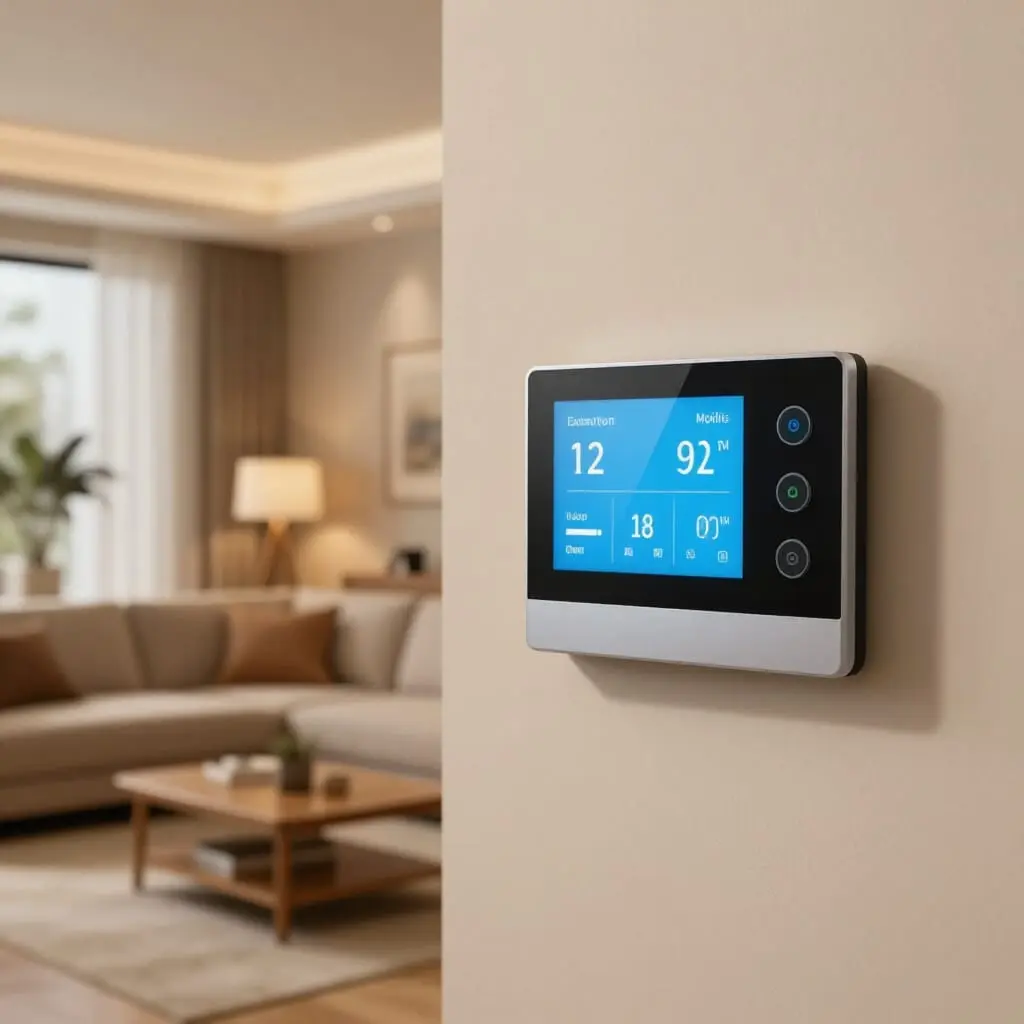 →
Smart Heating: Save Money & Boost Comfort | Complete Guide
Save 12-18% on annual heating costs while increasing home comfort. Discover our complete guide to smart thermostats, valves, and expert tips.
Lire l'article → →
Smart Plugs: 10 Practical Everyday Uses
Discover 10 practical ways to use smart plugs: save energy, automate routines, and improve security. Easy setup and compatible with Alexa and Google.
Lire l'article → →
Presence Detector: Real Comfort or Smart Home Gadget?
Is a presence detector worth it? Discover which rooms benefit most, real energy savings, and the technical limits of this smart home technology.
Lire l'article → →
Smart Home Essentials: The Best Gear for Beginners
Discover 5 essential smart home devices: hubs, lighting, thermostats, security, and smart plugs. A complete guide to getting started.
Lire l'article →