
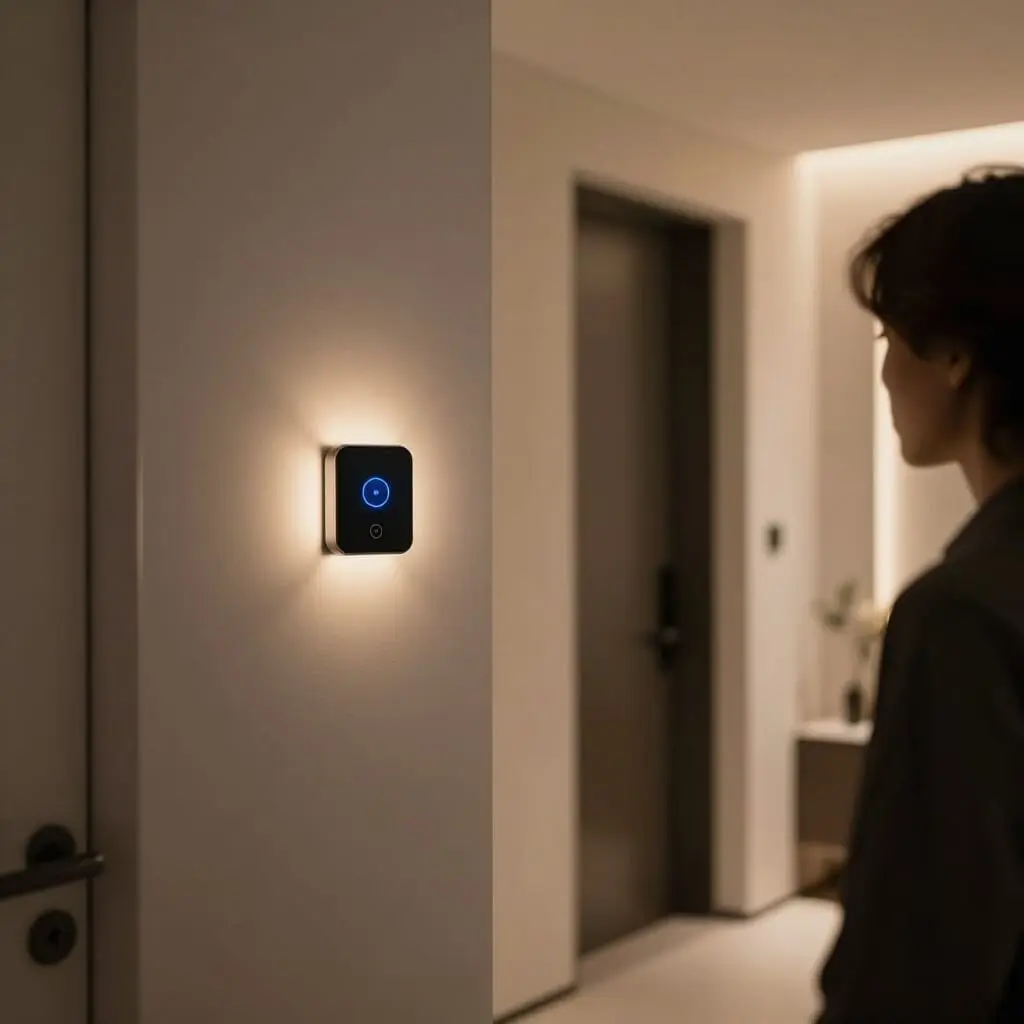
Presence Detectors: Real Comfort or Just a Smart Home Gadget?
- Presence detectors are most effective in high-traffic areas or rooms with long-term occupancy: hallways, garages, bathrooms, or offices.
- Claimed energy savings (up to 30% on lighting) primarily apply to offices and large spaces, not a small 20 m² living room.
- True comfort depends on the model: a classic PIR sensor triggers on movement, while microwave or mmWave sensors can detect presence even when you are still.
- False triggers, blind spots, pets, and drafts remain the main sources of frustration.
- In rooms where people stay continuously (bedrooms, fixed home offices), the investment is rarely worth it compared to a simple switch or a scheduled automation.
A presence detector is worth it in a hallway, a garage, a bathroom, or an entryway—anywhere you pass through without stopping and don’t want to fumble for a light switch. It becomes much more debatable in a living room or an office where you sit for long periods: low-end Passive Infrared (PIR) models turn the lights off as soon as you stop moving, and even more advanced microwave or mmWave sensors—capable of detecting even a person’s breathing—cost significantly more for marginal comfort gains once you have adjusted the timeout settings. The question, therefore, is not “yes or no,” but “in which room, with what budget, and for what specific use?”
Motion Detector vs. Presence Detector: A Marketing Confusion
Commercial terminology often mixes two technologies with very different uses, and this confusion explains much of the user disappointment.
A motion detector, usually Passive Infrared (PIR), detects thermal radiation changes caused by movement. It is inexpensive, robust, and perfectly suited for occasional use: turning on an outdoor light as you pass by, triggering an alarm, or signaling an intrusion. Its structural limit: if a person remains still, the sensor detects nothing and cuts the light after the set delay, even if the room is still occupied.
A presence detector adds a layer of sophistication, generally through microwave technology, a dual PIR + light sensor, or more recently, mmWave radar. These sensors identify micro-movements—such as breathing or a hand moving on a keyboard—and can keep the lighting active as long as a person remains in the zone, whether moving or still. Some advanced models can even divide a room into several detection zones and track multiple occupants simultaneously.
This technical distinction is not a minor detail: it determines whether the device solves a real problem (sitting in the dark while working at a desk) or simply adds a feature that few household scenarios actually utilize. Many homeowners buy a high-end “presence detector” for a use case that would have been perfectly covered by a $15 motion detector; conversely, others install a basic PIR in an office and get frustrated by constant light cut-offs.
Comfort is Great, But Only in Certain Rooms
The comfort benefit of a presence detector is not uniform throughout a home; it varies significantly based on the room’s function and how it is occupied.
In transit zones—hallways, entryways, staircases, pantries, or garages—the gain is clear and immediate. You walk in with your hands full of groceries, it’s dark, and the light turns on without a gesture: this is the most successful use case for a presence detector, where even an entry-level model is more than enough.
In short-stay rooms (bathrooms, laundry rooms, walk-in closets), the comfort is real but more marginal: a standard switch requires a one-second gesture that you would perform anyway upon entering.
It is in long-stay/stationary rooms—offices, living rooms with a TV, or bedrooms for reading—that the benefit-to-complexity ratio flips. A basic PIR becomes a source of annoyance (turning off during a video call), while a high-performance presence sensor capable of detecting stillness generally costs several dozen dollars more than a standard switch, providing a service that the user could just as easily provide themselves by pressing a button. The comfort exists, but it is most expensive and least necessary exactly where marketing sells it most heavily.
Energy Savings: A Promise That Requires Context
The economic argument is the most frequent one used in manufacturer communications, and it should be approached with caution.
The most cited figures, suggesting reductions of up to 30% in lighting consumption, come from studies conducted in commercial environments: offices, corporate hallways, and parking lots—vast spaces with intermittent occupancy that are often lit continuously by default before a system is installed. Applying this figure to a private home is misleading: lighting represents only a limited fraction of a household’s electricity bill, far behind heating and hot water, and most occupants already instinctively turn off the lights when leaving a room.
A presence detector provides real savings in cases where forgetting is frequent: garage lights, basement lights, hallways, or guest bathrooms left on by children or out of habit. In these rooms, automation corrects a recurring behavior, and the return on investment can be achieved in a few months, especially if energy-intensive older bulbs are still in use.
Conversely, in a living room or bedroom where lights are already conscientiously turned off, the detector merely reproduces a gesture already made manually—resulting in no measurable savings, and sometimes even a slight increase in consumption due to the sensor’s own electronics, which remain powered on even when no detection is occurring.
Security: A Real Plus, But Not a Standalone Solution
A presence or motion detector has an established role in security, provided you do not attribute virtues to it that it does not possess.
When paired with an alarm system or a camera, it acts as a deterrent: an outdoor light turning on as someone passes, or an alert sent to a smartphone when movement is detected in the occupants’ absence, complicates a burglar’s job and reduces the element of surprise. This is a use case where the cost/benefit ratio is generally favorable, particularly for entryways, walkways, and poorly lit outdoor areas.
On the other hand, a detector alone, without an alarm hub or notifications, protects nothing: it triggers a light or a local sound, but it doesn’t warn anyone or prevent a determined intruder. The confusion created by some online retailers between a “presence detector for lighting” and a “motion detector for alarms”—two products with very different specifications—sometimes leads buyers to believe they are securing their home when they have only installed a lighting convenience accessory.
For serious security use, it is better to choose a sensor explicitly designed and certified for alarms, with appropriate detection range and integration into a notification system, rather than a consumer-grade lighting sensor repurposed for security.
Daily Frictions That Marketing Won’t Show You
Before equipping a room, it is worth knowing the most frequently reported annoyances, as they directly impact real satisfaction.
False triggers are the leading complaint: a pet crossing the room, a curtain moving in a draft, or shifting sunlight can cause the light to turn on for no reason—or worse, never turn off as long as the cat remains in the sensor’s field of view. Dual-technology models (PIR + microwave) reduce this phenomenon but do not eliminate it entirely.
Blind spots and limited range pose problems in irregularly shaped rooms: a sensor placed in the wrong spot leaves a section of the office or walk-in closet out of range, causing the light to turn off even while the room is occupied.
Adjusting timeouts and sensitivity often requires several attempts to find a satisfactory compromise between comfort (not turning off too early) and economy (not leaving it on too long)—a step rarely mentioned in product descriptions.
Finally, for connected models, the question of privacy must be asked: some advanced presence sensors transmit detection data to the manufacturer’s cloud, raising concerns about the storage of information regarding occupancy patterns in the home. Local solutions that do not use the cloud exist, but they sometimes offer fewer advanced features.
Gadget or Useful Investment: How to Decide Room by Room
Rather than making a global “for or against” decision, choose reasonably room by room by weighing three simple criteria.
Frequency of transit without long stays: hallways, garages, entryways, basements, bathrooms—a basic motion detector is almost always justified here, as the gesture it replaces (fumbling for a switch while your hands are full or in the dark) has real value.
Duration of stationary occupancy: offices, living rooms, bedrooms—only an advanced presence detector (microwave or mmWave) will work correctly here, which significantly increases the budget per detection point. In these rooms, the question is simple: does the comfort of automatic lighting justify the extra cost compared to a standard switch and the risk of annoyance if settings are wrong?
Observed frequency of forgetting: if no one in the household ever forgets to turn off the light in a given room, automation provides neither extra comfort nor measurable savings—it simply adds another electronic component that is liable to fail.
In practice, the most cost-effective setup for a middle-class household is often limited to two or three strategic points (garage, hallway, outdoor entryway), rather than a blanket “smart home” package applied to every room.
Budget and Installation: What to Really Plan For
The real cost of a presence detector often exceeds the displayed price of the device itself, which changes the economic equation.
A basic PIR motion detector costs a few dozen dollars to purchase and can be installed in minutes to replace an existing switch, requiring no special skills beyond basic electrical safety. A connected presence detector using microwave or mmWave technology, with integration into a smart home ecosystem (Zigbee, Wi-Fi, Matter), costs significantly more per unit, and its installation may require a professional if it involves recessed wiring rather than a simple surface mount.
Added to this price is the setup time: sensitivity, detection zones, timeout settings, and zone exclusion (to prevent a pet from triggering the device)—a configuration process that often takes several days of adjustments to achieve satisfactory behavior, which can deter less tech-savvy users.
Finally, maintenance is limited but not zero: occasional cleaning of the sensor lens, replacing batteries for wireless models, and the potential obsolescence of the connectivity protocol if the device relies on a proprietary app or cloud. These indirect costs, rarely highlighted, should be factored in before multiplying the number of detection points in your home.
What is the difference between a motion detector and a presence detector?
A motion detector (PIR) reacts to movement and cuts the light if the occupant remains still. A presence detector, often using microwave or mmWave radar, also picks up micro-movements and maintains lighting even during prolonged stillness.
Do presence detectors actually lower electricity bills?
Especially in rooms where lights are frequently left on: garages, hallways, basements, bathrooms. In rooms where manual switching is already systematic, the real savings are marginal, if not zero, once the sensor’s own power consumption is taken into account.
Can I install a presence detector myself?
A simple model replacing an existing switch is accessible to a capable DIYer, provided basic electrical rules are followed. A recessed model or one requiring new wiring justifies hiring an electrician.
Why does my detector trigger for no reason?
The most common causes are a pet in the detection field, a draft moving a curtain, or a sudden change in light levels. Finer sensitivity adjustments and better sensor positioning can limit these false triggers.
Is a presence detector enough to secure a house?
No. On its own, it only triggers a light or a local signal without notifying anyone. Real protection requires pairing it with an alarm system that includes a hub and notifications, or a connected video surveillance system.
In which rooms is a presence detector truly useful?
Mainly in transit zones without long-term occupancy: hallways, entryways, garages, basements, bathrooms. In rooms with long-stay stationary occupancy (offices, living rooms), only an advanced microwave or mmWave model works correctly, at a higher cost.
Do connected presence detectors pose a privacy risk?
Some models transmit detection data to a manufacturer’s cloud server, which raises questions about how information regarding home occupancy patterns is handled. Local alternatives that do not use the cloud exist to mitigate this risk.
Sources
- The difference between motion and presence detectors — Verisure
- Presence detector or motion detector, which one to choose — Domomat
- Presence sensor vs. motion sensor — Aqara
- Presence detectors: the key to a smart and energy-efficient home — Futur Énergie

D'autres conseils Electrical Systems & Smart Home
 →
Smart Home Guide: How to Fully Automate Your House
Learn how to build a truly smart home: protocols, automation tips, budget, and essential gadgets to get started the right way.
Lire l'article → →
Smart Plugs: 10 Practical Everyday Uses
Discover 10 practical ways to use smart plugs: save energy, automate routines, and improve security. Easy setup and compatible with Alexa and Google.
Lire l'article → →
5 Warning Signs of a Dangerous Electrical Installation
Learn how to spot a dangerous electrical installation: tripping breakers, blackened outlets, and exposed wires. Essential safety tips and advice.
Lire l'article → →
Smart Home Essentials: The Best Gear for Beginners
Discover 5 essential smart home devices: hubs, lighting, thermostats, security, and smart plugs. A complete guide to getting started.
Lire l'article →