
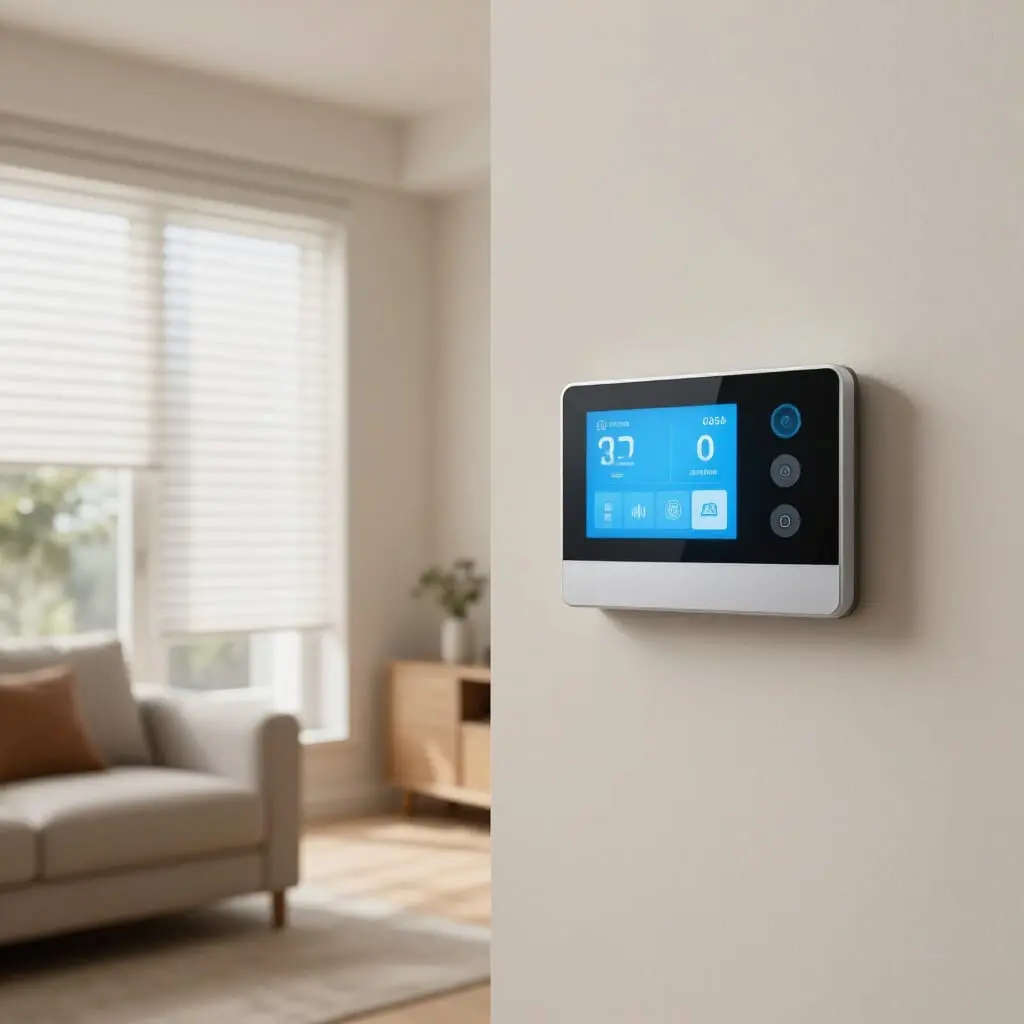
Smart Home and Energy Savings: What Actually Works
- Smart thermostats remain the most cost-effective smart home device, with heating bill reductions estimated between 5% and 15% according to energy studies—and up to 30% for the most advanced models.
- Smart plugs don’t save money by magic: their value depends entirely on how they are used, specifically for cutting off “vampire power” (standby consumption).
- A household that combines several smart solutions (heating, lighting, shutters) can reduce its electricity bill by $200 to $400 per year.
- The return on investment (ROI) for a complete smart home setup generally ranges from 18 months to 7 years, depending on the scale of the project.
- Automation without monitoring your habits isn’t enough: real savings come from scenarios tailored to the actual daily life of the household.
Does smart home technology really lower your energy bills, or is it mostly marketing hype to sell connected gadgets? The answer is nuanced. Certain devices, such as smart thermostats or automated shutters, produce measurable and documented savings. Others, like a poorly used smart plug, won’t change your consumption at all. What distinguishes a practical example of smart home energy savings from a useless investment is not the technology itself, but how it is configured and used daily. This article reviews the solutions that actually deliver on their promises, using sourced figures and real-world use cases for middle-class homeowners looking to save without breaking the bank on equipment.
What Smart Home Tech Can Actually Save You
Before detailing the equipment, we need to set an honest framework: smart home technology doesn’t create energy; it prevents waste. Its effectiveness depends directly on three factors: the targeted area of consumption, the quality of the home’s insulation, and how rigorously the automated scenarios are configured.
Heating remains the most powerful lever, as it typically represents nearly two-thirds of a household’s energy bill. This is why the most documented gains almost always involve heating: according to energy experts, a programmable thermostat can save between 5% and 15% on heating consumption—a figure that climbs to 30% with advanced smart thermostats capable of learning household habits.
Lighting and electrical appliances weigh less in the overall budget but are far from negligible over a full year. A household that combines several automations—controlled heating, scheduled lighting, and eliminated standby power—can aim for a reduction of $200 to $400 per year on its electricity bill, a figure consistent with feedback from various energy comparison services.
However, you should be wary of overly optimistic promises like “up to 40% savings.” These figures almost always refer to homes that were poorly equipped to begin with (no thermostat, unregulated electric heating, no scheduling) and involve a combination of multiple solutions, rather than a single connected device installed in isolation. For a home that is already well-insulated and equipped with modern heating, the margin for improvement is naturally smaller.
The Smart Thermostat: The Undisputed Star
If only one smart home device were to be chosen for its savings-to-investment ratio, it would be the smart thermostat. The principle is simple: it regulates temperature room-by-room or for the entire home, taking into account actual occupancy, outdoor weather, and time-based habits, whereas a traditional thermostat often imposes a single fixed setting all day long.
In practical terms, a household that previously heated its home at a constant 20°C (68°F) can program a drop to 17°C (63°F) at night and during absences, with an automatic temperature rise one hour before they return. This fine-tuned management, which is difficult to replicate manually every day, explains most of the 5% to 15% gain noted by experts. The most advanced models, which detect when windows are opened or anticipate a building’s thermal inertia, can push this number higher, though performance varies significantly based on the type of heating (gas, electric, heat pump) and insulation quality.
The entry-level budget is reasonable: models compatible with individual boilers start around $100 to $150, while multi-zone systems with smart radiator valves for every unit can exceed $400 for a medium-sized home. With an annual saving of $100 to $200 on a standard gas heating system, the return on investment often sits between one and three years, making it one of the few smart home devices that is profitable in the short term without needing government subsidies.
A word of caution: the thermostat only follows the instructions you give it. A household that sets a comfort temperature that is too high by default, or never configures “away” modes, will see no savings despite the investment.
Smart Lighting: Automating Rather Than Forgetting
Lighting carries less weight in the total bill than a heating system, but it remains one of the areas where waste is most frequent—simply because it is easy to forget a light on in an empty room. Smart home tech intervenes here not through the power of the bulb itself, but through the automation of its use.
Motion detectors paired with smart bulbs or switches automatically turn off an unoccupied room after a set period, eliminating waste without requiring residents to remember. Combined with light sensors, they also prevent artificial lighting from turning on when natural light is sufficient—a particularly useful setup for hallways, garages, or rooms without direct windows.
Switching to smart LED bulbs provides a benefit that stems as much from the LED technology itself (consuming five to ten times less than halogen bulbs) as from the programming that comes with it. The real value of connectivity is measured mostly in “presence simulation” scenarios during long absences, which are more about security than strict energy savings.
For a controlled budget, the logical order of priority is to first replace energy-hungry bulbs with LEDs, then add motion detectors in transition areas (hallways, entrances, garages, bathrooms), before considering full centralized lighting control. This progressive approach avoids investing in a sophisticated solution for marginal gains compared to a simple bulb change.
Smart Plugs: A Tool, Not an Automatic Solution
Smart plugs are often presented as a simple way to save money, but the reality is more nuanced: a smart plug doesn’t reduce consumption by itself; it measures consumption and allows you to cut it remotely or on a schedule. The gain depends entirely on how the household uses them.
Their most profitable use concerns the hunt for vampire power: internet routers, chargers, TV set-top boxes, printers, or coffee machines often stay plugged in continuously even when only used for a few hours a day. A plug programmed to cut power at night or during office hours eliminates this “phantom” consumption, which can represent dozens of kilowatt-hours per year per device, depending on how many gadgets are involved.
Another useful application is the measurement function: many smart plugs display real-time consumption of the connected device, allowing you to identify the home’s invisible high-consumers (an old freezer, a forgotten space heater) and make an informed decision on whether to replace them or change how they are used.
On the other hand, plugging a smart plug into a device that already uses very little energy, or never configuring a schedule, produces no measurable savings—the household simply pays for a remote control feature it isn’t using. It is a low-cost entry item ($15 to $30 per unit) whose true profitability relies entirely on consistent use.
Automated Shutters and Blinds: Managing Solar Gain
Less frequently mentioned in smart home and energy-saving discussions, automated shutters and blinds play a real role in a home’s thermal regulation, especially in both summer and winter.
In winter, a scenario that automatically closes the shutters at sunset creates an extra layer of insulation against the windows, reducing nighttime heat loss without manual intervention. Conversely, a programmed opening during the sunniest hours of the day on south-facing facades allows you to capture free solar heat and limit the need for heating.
In summer, the mechanism reverses: closing the shutters during the hottest hours of the day limits indoor overheating and reduces the need for air conditioning or fans—a use case that is becoming increasingly important with the rise of heatwaves in recent years.
The benefit of automation here is not to replace an action the occupant could do manually, but to make it systematic even when they are away—an empty house during the day benefits from the same thermal regulation as an occupied one. The installation cost depends heavily on what is already there: motorizing existing roller shutters is significantly cheaper than a full replacement, making this a highly variable cost from one home to another.
What Doesn’t Work (or Works Poorly)
Demystifying smart home tech also requires recognizing its limits, which manufacturers often keep quiet about. Three cases deserve mention.
First, voice assistants and smart speakers, despite their popularity, do not provide any energy savings in themselves: they are a command interface, not a regulation system. Their real value depends entirely on the smart home scenarios they are linked to.
Second, multiplying connected objects without a cohesive plan can actually degrade a home’s energy profile: every connected device consumes electricity itself in standby mode to stay reachable on the network, and a poorly sized or redundant smart home hub adds a permanent consumption that eats away at the gains made elsewhere.
Third, automation cannot compensate for a poorly insulated home. A sophisticated smart system installed in an “energy-inefficient” house (a “thermal sieve”) will optimize how energy is used, but it will never significantly reduce consumption when the root cause is structural. In this case, insulation work remains a higher priority than connected equipment, even if smart home tech can later usefully complement a renovation already completed.
Finally, a poorly configured scenario can produce the opposite of the intended effect: heating programmed to rise too early before a return, or overlapping automations that lack logic, can sometimes consume more than simple, consistent manual management.
Smart Home and Energy Savings: Real-World Examples by Property Type
Gains vary significantly depending on the type of housing, which explains the discrepancies seen in different user experiences.
In a 50 m² (approx. 540 sq ft) apartment heated with gas via an individual boiler, installing just a smart thermostat, combined with day/night and “away” programming, typically produces the standard savings noted by energy studies—an annual saving of dozens to a hundred dollars depending on gas prices and previous habits. This is the simplest and fastest way to see a return.
In a 100 m² (approx. 1,075 sq ft) house with electric heating via individual radiators, combining smart radiator valves in each room, differentiated programming by usage (bedroom, living room, office), and cutting off vampire power, can reach the $200 to $400 annual savings cited by energy comparators. This requires a higher initial investment due to the number of radiators to equip.
In a larger house equipped with roller shutters, adding thermal automation for the shutters to complement connected heating reinforces the gains during winter and summer months without additional running costs once installed, mechanically improving the savings-to-investment ratio over time.
A common thread emerges from these three profiles: savings never come from a single, isolated connected object, but from the coherent combination of several automations centered on heating—the dominant part of a household’s energy bill.
Return on Investment: How Long to Break Even?
The question of ROI remains central for middle-class homeowners who want to avoid investing in a gadget that offers no long-term economic benefit. Timelines vary greatly depending on the scale of the project.
For a smart thermostat alone, installed on an existing boiler, the ROI generally falls between one and three years, making it the safest smart home equipment based on this criterion. It is also the recommended entry point to test the benefits of smart home tech before going further.
For a more complete smart home installation—multi-zone heating, automated lighting, motorized shutters, motion sensors—the initial cost climbs quickly, and the ROI stretches out, generally between five and seven years depending on the complexity of the project and the chosen equipment. This timeframe is comparable to many traditional energy renovation projects, which puts the idea of a disproportionate investment into perspective.
A factor often underestimated in these calculations is the lifespan of the equipment itself: a thermostat or smart hub generally remains functional for several years, but a change in protocol or the end of software support by the manufacturer can reduce the actual amortization period compared to the initial theoretical calculation. Prioritizing equipment compatible with open and widely adopted standards limits this risk of premature obsolescence.
How to Start Without Breaking the Bank
For a middle-class household looking to test smart home tech without committing a disproportionate budget, the logical order of priority follows the heaviest areas of consumption.
Step one, and by far the most profitable, is to install a smart thermostat on your existing heating system, configuring realistic time slots and an “away” mode from the start. This single action covers most of the potential savings identified by reference studies on the subject.
Step two is to tackle vampire power with a few targeted smart plugs on the highest-consuming devices identified (routers, audiovisual equipment, multiple chargers), rather than systematically equipping the entire house.
Step three, if the budget allows, focuses on lighting transition areas with motion detectors, before considering full centralized control.
Finally, motorizing existing shutters can complete the setup, especially in homes exposed to significant seasonal thermal variations. This step-by-step progression allows you to verify the real impact of each investment on your bill before moving to the next, rather than buying a complete smart home pack where some elements may remain underutilized.
How much can I save with smart home technology?
Savings depend on what you target: between 5% and 15% on heating bills with a smart thermostat according to energy experts, and up to $200-$400 per year on electricity for a household that combines several automations (heating, lighting, standby power).
What is the first smart home device I should install to save energy?
A smart thermostat, because heating is the largest consumption item in a home’s energy budget and offers the fastest return on investment, generally between one and three years.
Is smart home tech profitable in a small home?
Yes, a studio or small apartment can still benefit from a smart thermostat alone with a limited investment, even if the absolute savings are proportionally lower than in a large house.
Do I need to automate everything to see savings?
No, a targeted installation focused on heating is often enough to capture most of the gains. Multiplying connected objects without a coherent configuration can even add unnecessary permanent consumption.
Does a smart thermostat work with all types of heating?
Compatibility varies: individual gas boilers, electric radiator heating, and heat pumps all use different thermostat models. You must check compatibility before purchasing.
Do smart plugs really lower the bill?
Only if they are used to cut off standby power or programmed with specific schedules. A smart plug plugged in without any configuration produces no measurable savings.
How long does it take to see a return on a smart home installation?
One to three years for a smart thermostat alone, up to five to seven years for a complete installation integrating heating, lighting, and automated shutters.
Does smart home technology work without a monthly subscription?
Most basic thermostats and smart plugs work without a subscription, using a free app. Some advanced services (detailed history, premium cloud features) may require an optional subscription depending on the brand.
Sources
- Hellowatt — Smart thermostat and energy savings
- La Maison Intelligente — Reducing your electricity bill with smart home tech
- VF Elec — Cost and profitability of a smart home installation
- Domizi — 10 examples of energy savings with smart home tech
- Selectra — Smart plugs and smart homes: do they really lower the bill?

D'autres conseils Electrical Systems & Smart Home
 →
Smart Roller Shutters: Are They Worth the Investment?
Discover if smart roller shutters are actually useful: comfort, energy savings, costs, and real-world benefits explained.
Lire l'article → →
Smart Home Essentials: The Best Gear for Beginners
Discover 5 essential smart home devices: hubs, lighting, thermostats, security, and smart plugs. A complete guide to getting started.
Lire l'article → →
Smart Home Guide: How to Start Your Automation Journey
Start your smart home journey: a complete guide to choosing your first devices, starting budgets, and easy DIY installation.
Lire l'article → →
Smart Home Security: The Complete Guide
Learn how to secure your home with smart technology. From cameras to smart locks, discover all the essential devices for a safer connected home.
Lire l'article →