
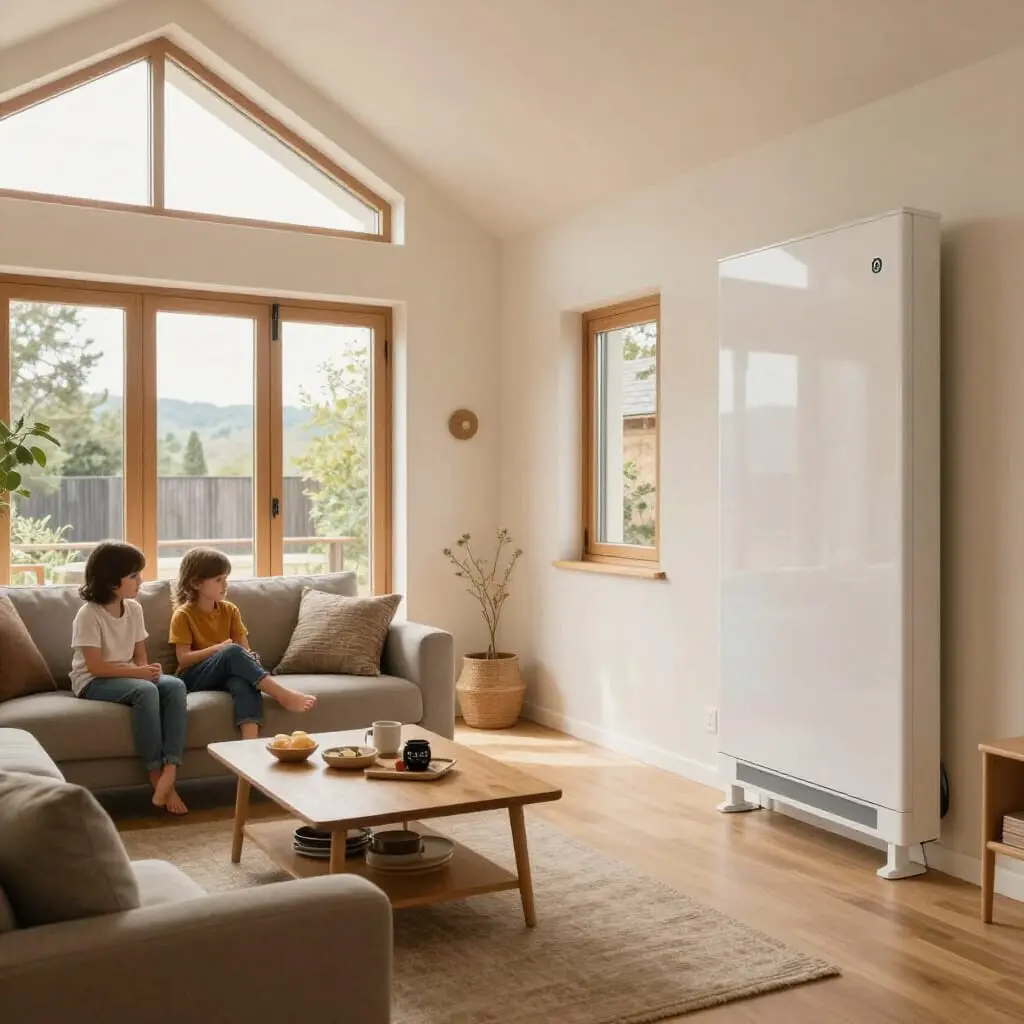
How to Improve Your Home’s Thermal Comfort? The Complete Guide
- Thermal comfort depends on four combined factors: air temperature, surface temperature, humidity, and air movement—not just the number on your thermostat.
- Thermal bridges can account for 5% to 10% of your heating bill according to energy experts; these must be addressed before investing in a new heating system.
- The order of work matters: prioritize the roof, then walls, then floors, before rethinking ventilation and heating to avoid wasting your investment.
- Summer comfort relies as much on thermal mass and solar shading as it does on air conditioning.
- Simple daily habits (targeted ventilation, managing shutters, room-by-room heating adjustments) can provide measurable gains without any renovation budget.
A house can show 20°C (68°F) on the thermostat and still feel cold, or conversely, become stifling in the summer despite appearing well-insulated. This is because thermal comfort is not just a single number: it is the result of a balance between air temperature, the temperature of walls and floors, humidity levels, and air drafts. Improving this comfort means acting on several levers simultaneously—identifying structural weak points, insulating in the correct order, ensuring proper ventilation, adapting your heating, and adjusting a few habits—rather than relying on a single miracle solution. This guide details these steps in a logical order, from diagnosis to daily habits, to ensure a comfortable home in both summer and winter.
Thermal Comfort: What Does It Really Mean?
Thermal comfort refers to the sensation of well-being felt within a space, regardless of the temperature displayed by a thermometer. This sensation depends on four parameters that constantly interact. Air temperature is the most well-known, but it isn’t enough to explain why a room at 19°C might feel freezing near a poorly insulated window, or why a 21°C living room stays pleasant in a well-insulated house.
Surface temperature plays an equally important role: a cold wall absorbs heat from your body through radiation, creating a sensation of cold even if the ambient air is properly heated. This is the famous “cold wall effect,” common in older, poorly insulated homes or where thermal bridges exist. Conversely, well-insulated walls emit a gentle, consistent warmth.
Relative humidity also influences how you feel: air that is too dry can dry out mucous membranes and create a sensation of cold, while air that is too humid intensifies the feeling of heat in the summer by limiting the natural evaporation of sweat. A range of 40% to 60% relative humidity is generally considered comfortable.
Finally, air movement—cold drafts in winter or insufficient circulation in summer—completes the picture. A comfortable home is one where these four parameters are managed simultaneously, which explains why a single-minded approach (such as only changing the heating system) often yields disappointing results.
Identifying Your Home’s Weak Points Before Taking Action
Before starting any renovations, it is useful to precisely identify where your home’s thermal weaknesses lie to avoid investing in the wrong areas. Thermal bridges are the first target: these are zones where the building envelope has a break in insulation, typically at the junctions between walls and floors, around window frames, or at roller shutter boxes. According to energy studies, these weak points can represent up to 5% to 10% of heating costs, manifesting as cold walls, localized dampness, or mold.
A simple way to locate them is to run your hand along walls, corners, and window frames during cold weather: a noticeable temperature difference signals a thermal bridge or an air leak. Black marks or recurring dampness in the same spot are also reliable indicators.
Air permeability deserves separate attention from insulation: a house can be well-insulated but still lose heated air through gaps around doors, electrical outlets, or cable passages. A simple test involves walking around the house with a candle or a thin piece of paper during windy weather: a flickering flame or moving paper signals a parasitic air leak. For a more advanced diagnosis, a professional “blower door” test can precisely quantify air leaks, but this is only necessary if major renovations are planned. In most cases, a visual and tactile inspection is enough to establish a first list of priorities.
Insulating Step-by-Step: Roof, Walls, Floors—In the Right Order
Insulation remains the most impactful lever for thermal comfort, but its effectiveness depends heavily on the order in which the work is carried out. The roof must systematically be treated first: since heat naturally rises, a poorly insulated roof can be the primary source of heat loss in a detached house, and these works are generally the quickest to see a return on investment. Insulating unfinished or converted attics often provides the best ratio between cost and perceived comfort gain.
Next come the walls, which can be insulated from the inside (less expensive but slightly reduces living space) or from the outside (more costly but better at treating thermal bridges by continuously wrapping the building). Exterior insulation has the advantage of preserving the thermal mass of the walls on the interior side, which helps stabilize the ambient temperature over time—a particularly useful point for summer comfort.
Floors and ground levels, often neglected, complete this envelope: a slab or floor poorly insulated over a crawl space or basement generates a sensation of cold feet that can persist even with efficient heating. Finally, windows and doors should be evaluated last in most cases, unless they are visibly degraded: replacing windows before treating the roof and walls often leads to underutilizing that investment, as the heat loss simply shifts to other surfaces. Respecting this order—roof, walls, floors, then windows/doors—prevents wasting a limited budget on secondary items.
Ventilating Without Losing Heat (or Coolness)
A more airtight and better-insulated house raises a often underestimated question: air renewal. Without proper ventilation, moisture produced by cooking, showering, or simply breathing accumulates, promoting condensation, mold, and a sensation of stale air that degrades comfort even at the correct temperature.
Standard mechanical ventilation (often called single-flow ventilation) is present in most homes built after the 1980s; it extracts stale air from damp rooms and allows fresh air to enter through vents in dry rooms. Its main drawback is that it exhausts heated air without recovering any energy. Heat Recovery Ventilation (HRV) corrects this by capturing the heat from the extracted air to preheat the incoming air, which improves both comfort (less sensation of cold incoming air) and energy bills, albeit at a higher investment and maintenance cost.
In older homes without mechanical ventilation, regular manual airing remains essential: opening windows wide for a few minutes in the morning and evening, rather than leaving them slightly cracked open constantly, allows the air to renew without permanently cooling the walls, as the air refreshes faster than the walls can lose their heat. Conversely, intentionally blocking air vents to “limit cold drafts” is a mistake that worsens humidity and, paradoxically, the sensation of cold caused by stagnant, damp air.
Keeping the House Cool in Summer Without Air Conditioning
Thermal comfort is not limited to winter: heatwaves are becoming increasingly frequent and pose specific challenges that traditional winter insulation does not always solve. Insulation designed solely to retain heat in winter can, without additional precautions, encourage summer overheating by preventing the house from “breathing” at night.
The most effective first reflex is to block solar gain before it enters the home, rather than trying to remove heat once it has accumulated. External shading (shutters, blinds, awnings) is significantly more effective than indoor curtains or blinds because it intercepts solar radiation before it passes through the glass and heats the indoor air. Closing shutters and blinds on the south and west sides during the hottest hours of the day, and reopening them in the evening, significantly limits the rise in temperature.
Nighttime ventilation completes this strategy: opening windows wide at night and early in the morning, when the outside air is cooler than the inside air, allows you to evacuate the heat accumulated during the day and cool the building’s structure. This technique works even better if the home has good thermal mass—the ability of walls and floors to store nighttime coolness and release it gradually during the day. Dense materials (stone, concrete, brick) naturally offer better inertia than lightweight structures, but interior layouts that limit unprotected glass surfaces and good air circulation between rooms also help low-inertia homes better navigate hot periods.
Adapting Heating to the Building Envelope
Once the building envelope has been addressed (insulation and ventilation), the heating system can finally be sized and set up appropriately. An oversized heating system used to compensate for poor insulation often works in an “all or nothing” fashion, which creates uncomfortable temperature fluctuations and overconsumption. Conversely, a well-sized system for a high-performance envelope can run continuously at low power, providing more stable and even heat.
The choice between radiant heating and reactive heating depends precisely on this envelope: in a well-insulated house with high thermal mass, heating that diffuses a gentle, long-lasting warmth (radiant floor heating, thermal mass radiators) capitalizes on the temperature stability already provided by the structure. In a home that is occupied intermittently or is poorly insulated, a more reactive heating system, capable of raising the temperature quickly and then turning off, may prove more suitable and economical.
Room-by-room regulation provides a comfort gain that is often underestimated: every room has different needs based on its orientation, use, and occupancy times. Programmable thermostats or thermostatic radiator valves allow you to heat the living room more in the evening, reduce bedroom temperatures at night, and turn off heating in unoccupied rooms, without sacrificing comfort where it truly matters. This differentiated approach, more precise than a simple uniform boiler setting, reduces consumption while improving the sensation of comfort in living areas.
Small Adjustments and Daily Habits That Change Everything
Beyond any renovation budget, several simple habits significantly improve daily thermal comfort. Fine-tuning your heating is one of them: lowering the set temperature by just one degree in living areas, combined with different valve settings for different rooms, is often enough to correct discomfort without overconsuming.
Managing openings should also be adjusted according to the season: closing shutters at night in winter limits heat loss through windows, while opening them wide during sunny winter days allows you to benefit from free solar gain. In summer, the logic is reversed, as mentioned above.
Furniture and interior layout also influence thermal perception: a radiator hidden behind a sofa or long curtains will not diffuse heat effectively, while a rug on a cold floor reduces the sensation of cold surfaces at foot level. Smart sensors and thermostats, which are increasingly accessible, allow you to monitor temperature and humidity room by room and adjust settings based on real data rather than impressions; however, they are not a replacement for insulation or ventilation and are only truly useful when combined with an already decent building envelope. Finally, airing out the house for a few minutes after showering or cooking, rather than letting humidity linger, prevents it from redistributing throughout the home and creating a sensation of damp cold.
Where to Start Based on Your Budget
Given the many different levers available, it is useful to prioritize based on your available means. Without a renovation budget, the daily habits detailed above—room-by-room heating adjustments, managing shutters according to the time and season, and targeted ventilation—already provide measurable and free gains.
With a limited budget, addressing the most accessible thermal bridges (insulating unfinished attics, sealing window frames, insulating roller shutter boxes) generally offers the best ratio between cost and comfort gain, as these areas are quick to treat and account for a large portion of heat loss.
With a more substantial renovation budget, the order described previously—roof, walls, floors, then ventilation and heating—remains the gold standard to avoid wasting investment on secondary items before the fundamentals are addressed. In all cases, a prior diagnosis, even a simple one performed yourself, helps direct work toward the truly problematic areas rather than those that merely seem like a priority intuitively.
What is the ideal temperature for optimal thermal comfort?
There is no universal number, but 19-20°C (66-68°F) in living areas and 16-17°C (61-63°F) in bedrooms are commonly recommended benchmarks. Perception depends mostly on surface temperature and humidity, not just the number on the thermostat.
Does thermal comfort depend only on air temperature?
No. It results from four combined factors: air temperature, surface temperature (the cold wall effect), humidity levels, and air movement. A room can feel cold at the correct temperature if the walls are poorly insulated.
How do I know if my house has thermal bridges?
Run your hand along walls, corners, and window frames during cold weather: a distinct temperature difference signals a thermal bridge. Recurring dampness or mold in the same spot is another reliable indicator.
Should I insulate or change my heating first?
Insulate first. A new heating system installed in a poorly insulated envelope compensates for losses without fixing them, which wastes your investment. The recommended order is roof, walls, floors, then ventilation, and finally heating.
Is Heat Recovery Ventilation (HRV) essential for thermal comfort?
It is not essential, but it improves comfort by preheating incoming air using heat recovered from the exhausted air, which prevents the sensation of cold air entering the home. A well-maintained standard mechanical ventilation system or regular manual airing is sufficient in many cases.
How can I keep my house cool in summer without air conditioning?
Close external solar protections (shutters, blinds) as soon as the sun hits the facade, then open windows wide at night and early in the morning to evacuate accumulated heat and cool the building’s structure.
Does a smart thermostat really improve thermal comfort?
It helps refine room-by-room settings and monitor temperature and humidity in real-time, but it is not a replacement for insulation or ventilation. Its value is only realized when combined with a properly treated building envelope.
How much does improving home thermal comfort cost?
The cost varies greatly depending on the scope of work: daily habits and fine-tuning heating are free, while full insulation (roof, walls, floors) represents a larger investment but is generally paid for over time through heating savings.
Sources
- Thermal bridges in the home: a complete guide and assistance — Vertena
- Thermal insulation: the key to comfort and energy savings — Actis Isolation
- Summer comfort / Winter comfort — Knauf Insulation

D'autres conseils Energy-Efficient Renovation
 →
Electric Heating: Improve Performance & Save Energy
Learn how to optimize your electric heating: room-by-room control, maintenance, and smart home tech. Reduce your consumption by up to 25%.
Lire l'article → →
Best Heating Systems for Renovation: 2026 Comparison
Choosing a heating system for your renovation? Compare heat pumps, gas, wood, and electric options in our 2026 guide with practical expert advice.
Lire l'article → →
Energy Efficiency Renovation: What Actually Works
Discover the most effective energy renovation projects: insulation, heating, and ventilation. A complete guide to optimizing your home's energy consumption.
Lire l'article → →
Energy Renovation: Comfort, Savings & Home Value
Discover how energy renovation improves comfort, reduces bills, and boosts property value through insulation, heating, and smart upgrades.
Lire l'article →