
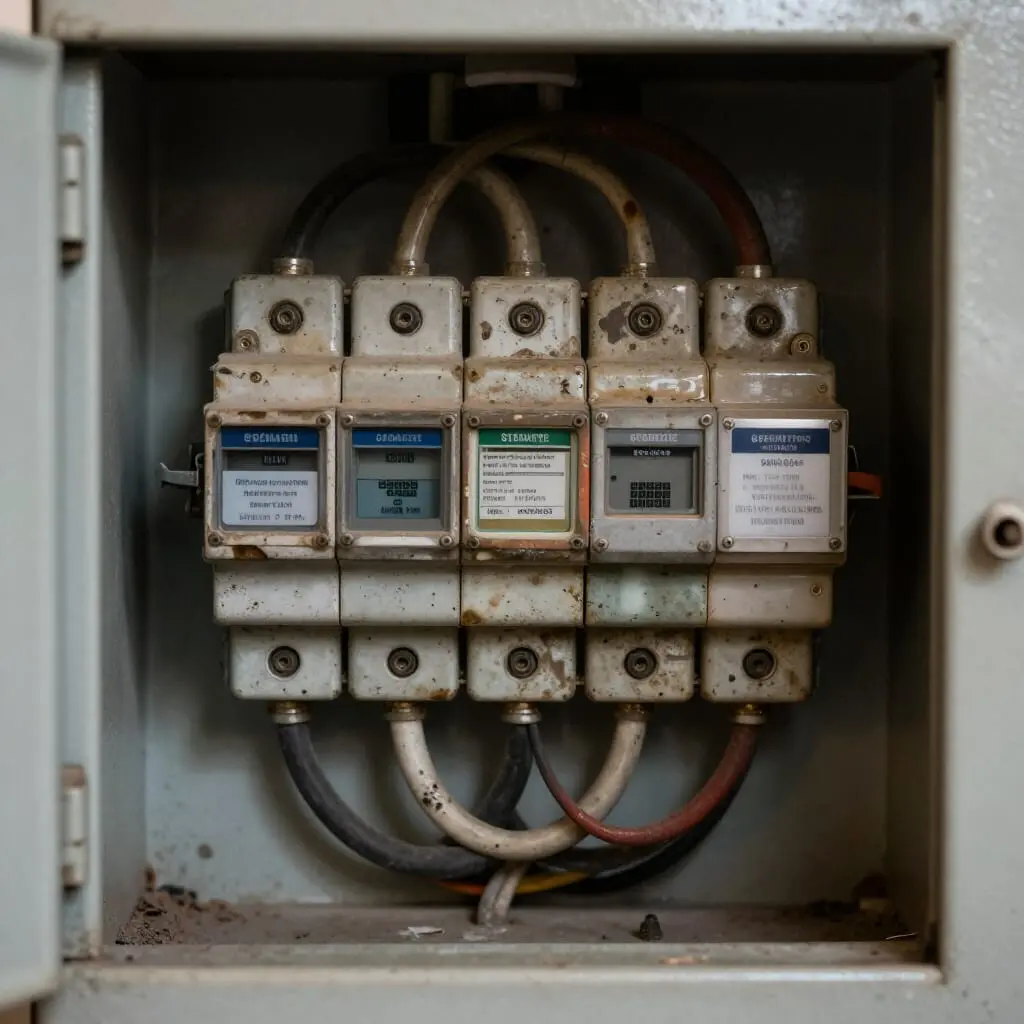
Old electrical systems: signs that should alert you
- Cloth-insulated wires, porcelain fuse boxes, or vintage black main breakers indicate an installation dating back to before the 1990s.
- Ungrounded, cracked, or overheating outlets should be your top priority, especially in kitchens and bathrooms.
- The absence of GFCI/RCD protection leaves the entire home without real protection against electrocution.
- Repeated outages, the smell of burning plastic, or frequent tripping suggest an end-of-life installation.
- An electrical safety audit can help prioritize necessary repairs before committing to a full renovation.
A smell of burning plastic near an outlet, a breaker that trips for no apparent reason, or a panel filled with porcelain fuses: these are often the first signs that an old electrical system is reaching the end of its lifespan. The danger lies in the fact that these signals can remain subtle for years before resulting in a power failure, an electric shock, or, in the most serious cases, a fire. Identifying these signs early doesn’t require specialized technical skills; you just need to know where to look—in the panel, at the outlets, and at exposed wiring—to determine if your home needs a professional inspection.
Cloth-insulated wires and aluminum wiring
The first sign of an old electrical system is often visible before you even open the service panel. In attics, basements, or behind false ceilings, wires covered in braided textile insulation rather than PVC plastic indicate wiring from the 1950s or 1960s. Over time, this insulation becomes stiff and brittle, exposing the bare copper to the slightest shock or friction. This risk is not theoretical: a stripped wire touching a metal structure or another damaged sheath can create a short circuit, sometimes causing localized overheating that remains invisible behind a wall.
Another material to watch for is aluminum wiring, which was commonly used until the 1970s due to its lower cost compared to copper. Aluminum expands and contracts more significantly with temperature changes, which gradually loosens the connections at the terminals of outlets and switches. Insufficient tightness causes micro-arcing and overheating at wire connectors or terminal blocks—a phenomenon that remains completely invisible until the cover is removed. If your home was built before 1975 and no one can confirm a complete rewiring, consider this a plausible risk rather than a minor detail.
Fuse boxes or vintage main breakers: the core system to monitor
The electrical panel itself concentrates several warning signs. A panel equipped with porcelain cartridge fuses, rather than modern modular circuit breakers, indicates an installation that has likely never been updated since its original installation. These fuses do not reset automatically: in the event of an overload, the cartridge must be replaced. Some occupants end up “fixing” this by using a higher-rated fuse or even a simple piece of wire, which completely removes all overcurrent protection.
The “vintage black main breaker”—a heavy, old-fashioned unit installed upstream of the panel—also deserves your attention. These devices most often date from the 1960s to the 1980s, and their internal mechanisms can oxidize over time, degrading the quality of the electrical contact and promoting overheating. Your utility provider may replace these for free or at a reduced cost upon request, a step many homeowners overlook even though it costs little to nothing. Finally, a panel where wires are running in every direction without labeling or organized conduits, or where certain circuits are no longer identifiable, reflects a history of successive, uncoordinated modifications. This is exactly the type of installation that defies consistent safety logic.
Ungrounded, cracked, or overheating outlets
Electrical outlets are the most direct point of contact between the system and the occupants, making them a particularly telling indicator. A two-prong outlet without a central grounding pin, typical of homes built before the late 1960s, means that if an insulation fault occurs in an appliance with a metal casing (such as an oven, washing machine, or heater), the leakage current has nowhere to escape and can pass through the user upon contact with the housing.
Beyond the lack of grounding, certain physical signs should trigger an immediate alert: an outlet where the plastic has turned yellow or black around the slots, a plug that visibly heats up after a few minutes of use, a slight sizzling sound when plugging something in, or an outlet that feels loose in its wall housing. These symptoms indicate poor contact that generates a localized hot spot, a phenomenon identical to that seen in poorly tightened aluminum connections. An outlet that regularly heats up should never be dismissed as a mere inconvenience to be bypassed by using a different plug; it is a sign of failure that requires replacement and potentially a professional inspection of the upstream circuit.
Missing GFCI/RCD protection: the missing safety net
A GFCI (Ground Fault Circuit Interrupter) or RCD (Residual Current Device) is the component that automatically cuts power the moment it detects a current leak to the ground—for example, if someone accidentally touches a faulty appliance. In installations built before the 1990s, this protection is frequently missing or only present on a portion of the circuits. In practical terms, this means an insulation fault in a household appliance could remain silent for weeks without any mechanism intervening to protect the occupants.
Identifying this absence is relatively simple: just open the panel and look for a module equipped with a test button marked “T” or a specific symbol. If the panel only contains standard individual circuit breakers without any residual current device at the head of the installation, you lack essential protection against electrocution. This is often the most critical finding in an electrical safety audit, as it concerns the immediate safety of people rather than just property. Installing one, unlike a complete rewiring, is a relatively quick and targeted intervention, making it the top priority recommended by electricians.
Frequent outages, smells, and overheating in daily life
Some signs cannot be seen but are felt in the daily use of the home. Repeated tripping, especially when a high-power appliance turns on (such as a cooktop, clothes dryer, or heater), often indicates a circuit that is undersized for modern usage. Homes designed in the 1960s or 1970s were generally not built to handle the simultaneous load of an oven, a dishwasher, and an electric vehicle or e-bike charger.
The smell of burning plastic or smoke, even if fleeting, around an outlet, a switch, or the panel itself, must never be ignored: it usually corresponds to an overheating connection point, a direct precursor to a fire. Similarly, flickering lights when a large appliance starts up, or a slight tingling sensation when touching a metal switch, indicate an insulation fault or grounding issue that should not be downplayed. These symptoms may seem minor when viewed in isolation, but their accumulation and repetition should trigger a professional inspection rather than a gradual acceptance of the problem.
Switches, exposed conduits, and permanent extension cords
Daily life in a home often reveals clues that we eventually stop noticing because they become part of the decor. Cables running along baseboards under simple exposed conduits, rather than being recessed into the walls, indicate an original installation that has been added to over the years without a complete overhaul. Porcelain or bakelite switches with dated designs, or three-way switches that are stiff or creaky, testify to the same aging process.
Another, more behavioral signal, deserves attention: the constant use of power strips or extension cords—not for occasional needs, but as a permanent solution because there aren’t enough outlets in a room. This reveals that the number of circuits was not designed for modern demands, a problem that a single dedicated line for a new oven or an internet router cannot mask. Finally, a total lack of outlets in certain wet rooms (bathrooms, laundry rooms) or lighting limited to a single central bulb per room without secondary light points betrays a design from a different era, when a household’s electrical needs were significantly lower than they are today.
What to do: diagnosis and prioritization
Spotting one or more of these signs does not necessarily mean you must redo your entire electrical system urgently. The first step is to have a qualified professional perform an electrical safety audit to evaluate the condition of the panel, the presence of grounding, the residual current protection, and the apparent state of the wiring. This inspection generally costs around $100–$150 and allows you to establish a list of priorities rather than an immediate, massive construction project.
Some interventions, such as adding a missing GFCI/RCD or replacing a vintage main breaker, are targeted and relatively quick to implement. Others, such as a complete rewiring or creating new dedicated circuits, are part of a global renovation strategy to meet current electrical codes. In a real estate transaction, an electrical inspection is often required for any system older than fifteen years, and its results can impact negotiations. Conversely, indefinitely delaying these checks exposes you not only to safety risks but also to the potential denial of insurance claims in the event of a fire or accident caused by a non-compliant installation.
How do I know if my electrical system is too old?
Check for porcelain fuses, a vintage black main breaker, two-prong outlets without ground pins, or cloth-insulated wires. If your home was built before 1990 and has never been updated, an electrical audit will confirm the true state of the installation.
Is an ungrounded outlet dangerous?
It is not inherently dangerous as long as no insulation fault occurs in the plugged-in device, but it removes a vital layer of protection against electrocution. The risk increases significantly in wet areas like kitchens or bathrooms.
Should I replace an old vintage main breaker?
Yes, these devices dating from the 1960s to the 1980s pose a risk of overheating due to the oxidation of their internal contacts. Your utility provider may replace them for free or at a reduced cost upon request.
What are the signs of an obsolete electrical panel?
A panel with cartridge fuses instead of modular circuit breakers, unlabeled wires running haphazardly, or the absence of a visible GFCI/RCD module are the main indicators that a panel needs upgrading.
Is a GFCI/RCD mandatory in an old house?
It is mandatory for any installation to meet current electrical codes, but its absence is common in older homes that have never been renovated. It is usually the first upgrade recommended by electricians because it directly protects against electrocution.
How much does an electrical safety audit cost?
An electrical audit generally costs between $100 and $150. It helps identify priority anomalies before you commit to renovation work, the cost of which can vary significantly depending on the scale of the project.
Can I sell a house without updated electrical standards?
Yes, but an electrical inspection is often mandatory for any system older than fifteen years during a sale. Identified anomalies do not prevent the transaction, but they will be included in the disclosure documents and can influence negotiations.
When should I completely rewire an old house?
A complete rewiring becomes necessary when several signs accumulate: aluminum or cloth-insulated wiring, a general lack of grounding, an obsolete panel, and circuits that are undersized for modern appliances. A preliminary audit can help you decide between targeted repairs and a full renovation.
Sources
- Selectra – Old electrical systems: 7 warning signs
- Promotelec – Electrical signs to watch for before buying an older home
- ChronoServe – Dangers of old electrical installations
- Grandemenuiserie – Old black main breakers, cost and replacement
- Ootravaux – Cost of electrical code upgrades

D'autres conseils Electrical Systems & Smart Home
 →
Smart Switches vs. Smart Bulbs: Complete Comparison Guide
Smart switches or smart bulbs? Compare costs, installation, and features to find the best smart lighting solution for your home.
Lire l'article → →
Smart Home Guide: How to Start Your Automation Journey
Start your smart home journey: a complete guide to choosing your first devices, starting budgets, and easy DIY installation.
Lire l'article → →
Smart Roller Shutters: Are They Worth the Investment?
Discover if smart roller shutters are actually useful: comfort, energy savings, costs, and real-world benefits explained.
Lire l'article → →
Smart Home Energy Savings: What Actually Works
Discover which smart home solutions truly reduce your energy bills. We analyze smart thermostats, plugs, and more for real savings and ROI.
Lire l'article →