
Dangerous Electrical Installations: Warning Signs You Shouldn’t Ignore
- Dangerous electrical systems often show warning signs before an accident occurs: tripping breakers, blackened outlets, or a burning plastic smell.
- Exposed wires, a lack of grounding, and the absence of a 30 mA RCD (Residual Current Device) are major red flags.
- Dangerous electrical setups (daisy-chaining power strips, hanging wires, or DIY “quick fixes”) significantly increase the risk of short circuits and fires.
- In many regions, an electrical safety inspection is required when selling or renting a property with an installation older than 15 years.
- If you are in doubt, having a qualified electrician perform a check is the only way to be sure.
A dangerous electrical installation rarely fails all at once; instead, it announces itself through a series of signals that most occupants learn to ignore over time. A circuit breaker that trips twice a week, an outlet that feels warm to the touch, or a slight smell of hot plastic near the panel—each of these clues might seem insignificant on its own. It is precisely their accumulation that should trigger an alarm. This guide details the visual, behavioral, and sensory signs that betray a dangerous electrical connection or an aging system, helping you know when it is time to have your home inspected before an incident occurs.
Visual warning signs you can’t miss
The first step in assessing the danger of an electrical system is to observe it without dismantling anything. A cracked, blackened, or deformed outlet or switch indicates past abnormal heating—often the result of poor contact or repeated overloading. This discoloration, sometimes subtle, is frequently accompanied by brown marks around the device, proof that an electrical arc has already occurred in that spot.
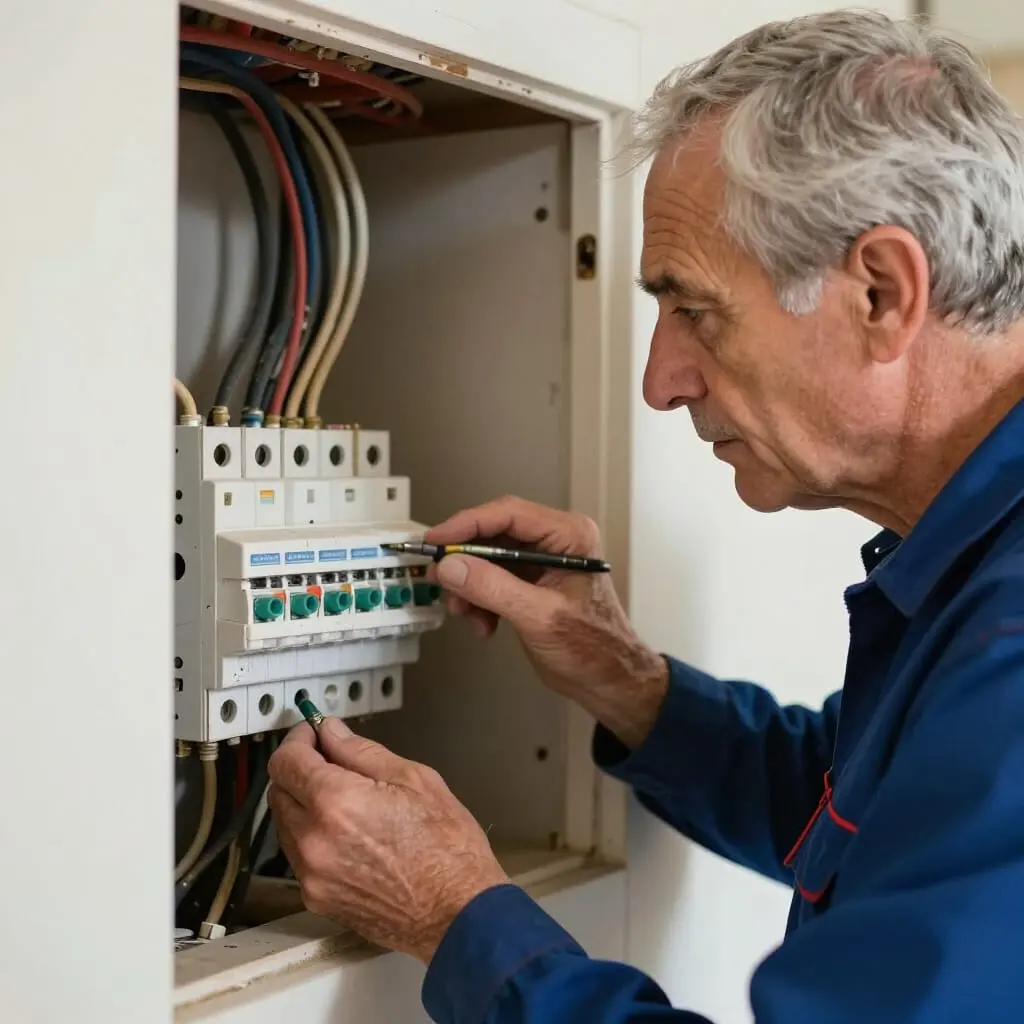
The electrical panel deserves special attention. A panel equipped with porcelain cartridge fuses rather than modern circuit breakers typically dates back to before the 1990s and lacks reliable residual current protection. Conversely, a recent but overloaded panel with messy, protruding wires or exposed terminal blocks outside the enclosure reveals a history of DIY “patchwork” rather than a professionally planned installation.
Exposed wires—visible behind a baseboard, above a false ceiling, or coming out of a damaged conduit—represent one of the most direct dangers. A simple accidental contact between a live wire and a metal surface is enough to cause a short circuit or electric shock. A split, chewed, or simply aged sheath that reveals the copper underneath must be treated as an emergency, not an aesthetic detail.
Finally, the lack of grounding—recognizable by a two-prong outlet without the third grounding pin, or in older homes that have never been renovated—deprives the system of its primary mechanism for diverting leakage current in the event of an appliance insulation failure.
Electrical symptoms that indicate a problem
Beyond visual appearance, it is often the daily behavior of the installation that reveals a hazard. A circuit breaker that trips repeatedly without any obvious connection to a specific appliance is not just a nuisance: it signals a circuit overload, an intermittent short circuit, or an insulation fault somewhere in the network. Dismissing it as a simple “glitch” and mechanically resetting it every day means ignoring a critical safety signal.
Flickering lights, especially when they occur when a large appliance starts up (such as an oven, washing machine, or hairdryer), usually indicate a voltage drop caused by poor contact, insufficient cable gauge, or a loose connection in the panel. This phenomenon, often minimized, frequently precedes a more serious failure.
Another frequent signal: appliances that give you a slight tingling sensation when touched, particularly those with metal casings (washing machines, refrigerators). This sensation, even if faint, indicates a leakage current that should normally be intercepted by a functional RCD—its presence betrays either the absence of such a device or a faulty one.
Finally, an outlet that heats up as soon as an appliance is plugged in, even a simple charger, should always be a cause for concern. Heat is caused by abnormal contact resistance, often due to worn internal components or insufficient tightening during wiring—a phenomenon that worsens over time and can escalate into a fire.
Smells and noises: sensory alerts you must never ignore
Some signs of a dangerous electrical installation cannot be seen; they must be smelled or heard. A smell of hot plastic or burning, even if fleeting, coming from an outlet, switch, or the electrical panel, almost always indicates that the plastic insulation on the conductors is overheating. Contrary to popular belief, this smell does not need to be strong or persistent to be significant: it often appears before any visible damage occurs.
Crackling, sizzling, or a low buzzing sound near an outlet, switch, or the panel signals a low-intensity electrical arc, usually due to poor contact. This noise, sometimes barely perceptible, often precedes a rapid worsening of the problem, as the electrical arc itself generates heat that further degrades the connection.
A sharp pop followed by a power cut most often corresponds to a direct short circuit, immediately stopped by the breaker. If it only happens once, the source might be a faulty appliance; if it repeats on the same circuit, the installation itself is the culprit.
In all these cases, the rule is simple: shut off the breaker for the affected circuit while waiting for a professional to intervene, rather than continuing to use the offending outlet or appliance in the hope that the problem will go away on its own.
The absence of protection devices: a silent danger
An installation can seem to function normally on a daily basis while lacking the protections that would limit the consequences of an accident. A 30 mA RCD (Residual Current Device or GFCI), mandatory on every circuit under modern safety standards, automatically cuts the power as soon as a leakage current dangerous to the human body is detected—typically during accidental contact with a live part. Its absence or malfunction (which can be checked by pressing the “test” button on the panel: if it doesn’t trip, it is defective) turns a simple insulation fault into a risk of severe electric shock.
Grounding plays a complementary role: it provides the leakage current with a path of least resistance to the ground, rather than through the body of a person touching a faulty appliance. Homes built before the 1970s or 1980s are often partially lacking this, particularly in wet rooms like bathrooms or kitchens, where the risk is highest.
Finally, breaker sizing must match the gauge of the wires they protect. An oversized breaker relative to the wiring—often the result of an improvised replacement after a failure—will not trip early enough during an overload, allowing the wire to heat up well beyond its capacity before a cut occurs. This is an invisible defect to the naked eye but can be identified during a panel inspection.
Dangerous electrical connections: risky daily habits
Even a technically compliant installation can become dangerous based on how it is used. Daisy-chaining power strips (plugging one power strip into another) is one of the most common and risky practices: it adds up the power load of all connected devices onto a single source, far exceeding what the original circuit and outlet were designed to handle.
Leaving extension cords coiled up while using high-power appliances (such as space heaters or electric ovens) is another frequent issue: the coil prevents the dissipation of heat generated by the current flow, which can melt the cable insulation from the inside out without any visible external sign until it is too late.
Sharing a single outlet for multiple high-power appliances (such as an oven and a dishwasher on the same line) overstresses a circuit designed for more modest use. In practice, this leads to the overheating and tripping mentioned earlier—but the true source of the problem is not the installation itself, but rather how it is being taxed.
Finally, certain connections considered “hacks”—such as direct wire splicing without a junction box, intentionally removing the third grounding pin to force a plug into an incompatible outlet, or connecting wires of different gauges without an adapter—are not only non-compliant, but they deliberately remove the safety margins provided by electrical safety standards.
What to do when you spot a warning sign?
Spotting one or more signs of a dangerous electrical installation does not mean you should panic, but it does mean you must act methodically. The first step is to shut off the power to the affected circuit at the panel, without attempting to repair a stripped wire or damaged outlet yourself: a poorly executed repair can increase the risk rather than reduce it, especially regarding grounding or protection sizing.
The second step is to have a professional inspection performed by a licensed electrician, capable of testing the entire installation with a multimeter and checking the compliance of the panel, circuits, and RCDs point by point. This technical diagnostic differs from the mandatory inspection required during a property sale: the latter is a regulatory overview for older homes but is not a substitute for corrective repairs.
In the meantime, a few precautionary measures can limit daily risk: unplug non-essential devices on the suspect circuit, avoid using a wet room if the installation seems faulty, and never let a child approach a visibly damaged outlet or wire. These actions do not fix the problem, but they reduce exposure to danger until professional help arrives.
Mandatory electrical inspections: a useful but limited guide
For any sale of a home where the electrical installation is more than fifteen years old, law often requires an electrical safety inspection by a certified professional, provided to the buyer before signing. This document, typically valid for three years during a sale and six years during a rental, checks a specific list of points: the presence and functioning of the RCD, the existence of grounding, the condition of aging equipment, and the absence of accessible bare wires.
This inspection is a good indicator, but it has a major limitation: it only covers points defined by regulation and is not intended to detect all the usage defects mentioned above, such as daisy-chained power strips or overloading habits. An installation can pass an inspection without major anomalies while still presenting risks related to how its occupants use it daily. Conversely, a home less than fifteen years old may not be subject to mandatory checks, even if a poorly executed extension or a kitchen renovated without updating the wiring has created a real danger.
Viewing this inspection as a starting point rather than an absolute guarantee helps avoid a false sense of security, especially for a buyer who might not be aware of the warning signs to watch for once they have moved in.
How can I know if my electrical installation is dangerous without calling a professional?
Look for visible signs: blackened or cracked outlets, exposed wires, a panel with only porcelain fuses, frequently tripping breakers, a burning smell, or outlets that feel hot. If multiple signs are present, a professional check is necessary.
What is the most urgent sign to address in an electrical installation?
An accessible exposed wire or a burning plastic smell near the panel are the most urgent signals: they directly precede a risk of short circuit, electric shock, or fire.
Can a dangerous electrical connection exist even in a recent installation?
Yes. Daisy-chaining power strips, using coiled extension cords under load, or sharing a single outlet between several powerful appliances creates a danger regardless of the age of the installation by overloading compliant circuits.
How can I check if the RCD (or GFCI) in my panel is working?
Every RCD has a built-in test button. By pressing it, the breaker should trip immediately; if it does not react, the device is defective and must be replaced without delay.
Is a mandatory electrical inspection enough to guarantee a home is safe?
No. While these inspections check specific regulatory points, they do not detect risky usage habits, such as overloading circuits or daisy-chaining power strips.
What should I do immediately if I spot an exposed wire in my home?
Turn off the breaker for that circuit at the panel, avoid all contact with the wire, and call an electrician to perform a repair before restoring power to the circuit.
How often should breakers trip before they are considered abnormal?
An occasional trip related to one specific appliance is normal. Repeated tripping without an identified cause over several weeks indicates an insulation fault or an overload that needs professional diagnosis.
Sources
- INRS — Electrical Risks
- Service-public.gouv.fr — Mandatory Electrical Inspections
- Les Dépanneurs de Paris — Signs of a dangerous electrical installation
- Promotelec — Exposed wires: take action

D'autres conseils Electrical Systems & Smart Home
 →
Smart Home Essentials: The Best Gear for Beginners
Discover 5 essential smart home devices: hubs, lighting, thermostats, security, and smart plugs. A complete guide to getting started.
Lire l'article → →
Smart Lighting: Practical Solutions for Daily Life
Discover how smart lighting simplifies your life: automation, up to 30% energy savings, home security, and affordable accessibility.
Lire l'article → →
Smart Roller Shutters: Are They Worth the Investment?
Discover if smart roller shutters are actually useful: comfort, energy savings, costs, and real-world benefits explained.
Lire l'article → →
Add Electrical Outlets Without a Full Rewire: Easy Methods
Learn how to easily add electrical outlets using daisy-chaining, surface trunking, or junction boxes. Practical solutions and cost breakdowns included.
Lire l'article →