
Heat Pumps: Everything You Need to Know Before Getting Started
- A heat pump extracts heat from the air, water, or ground to heat your home using 3 to 4 times less electricity than traditional heating.
- Budgets vary significantly by type: approximately €4,200 for an air-to-air unit, up to €25,000 for a geothermal system, including installation.
- Combined government grants (such as MaPrimeRénov’, CEE, and eco-loans) can cover between €11,000 and €16,000 depending on household income.
- An old, poorly insulated house can still use a heat pump, but it often requires a high-temperature model or prior insulation work.
- Choosing a certified (RGE) installer is essential for both installation quality and accessing public subsidies.
Are you considering replacing your gas or oil boiler with a heat pump (HP) but don’t know where to begin? The answer is simple: a heat pump captures the heat present in the outside air, water, or ground and redistributes it into your home, offering significantly higher efficiency than standard electric heating. Before you dive in, three questions always arise: which type of heat pump fits your home, what budget should you set aside after subsidies, and is your house actually suitable for this system? This guide answers those three questions in order, providing the concrete benchmarks you need to approach your first quotes with confidence.
How a Heat Pump Actually Works
The principle of a heat pump is based on a simple physical phenomenon: a refrigerant captures the calories present in the air, water, or ground—even in cold weather—then concentrates them using a compressor before releasing them as heat into your home’s heating circuit. This thermodynamic cycle—evaporation, compression, condensation, and expansion—is the same one used in a refrigerator, but in reverse: instead of extracting heat from an enclosed space and venting it outside, a heat pump extracts heat from the outside to vent it inside.
This mechanism explains why a heat pump often boasts a Coefficient of Performance (COP) between 3 and 4: for every 1 kWh of electricity consumed by the compressor, it delivers 3 to 4 kWh of heat. This is the key feature that sets it apart from a standard electric radiator, which converts electricity into heat with an efficiency of nearly 1 to 1.
However, this COP is not a constant; it varies based on the outdoor temperature, the type of heat pump, and the quality of the installation. An air-to-air or air-to-water heat pump will see its efficiency drop when temperatures plummet, whereas a geothermal heat pump—drawing heat from ground that remains at a stable temperature year-round—maintains much more consistent performance. Keep this in mind if you live in a region with harsh winters: the sizing of the unit and the choice of model must account for this from the start, otherwise, your backup electric heating costs could skyrocket.
The Three Main Families of Heat Pumps
Not all heat pumps are created equal, and your first major decision involves the heat source being used. Generally, there are three main types, each with its own uses and requirements.
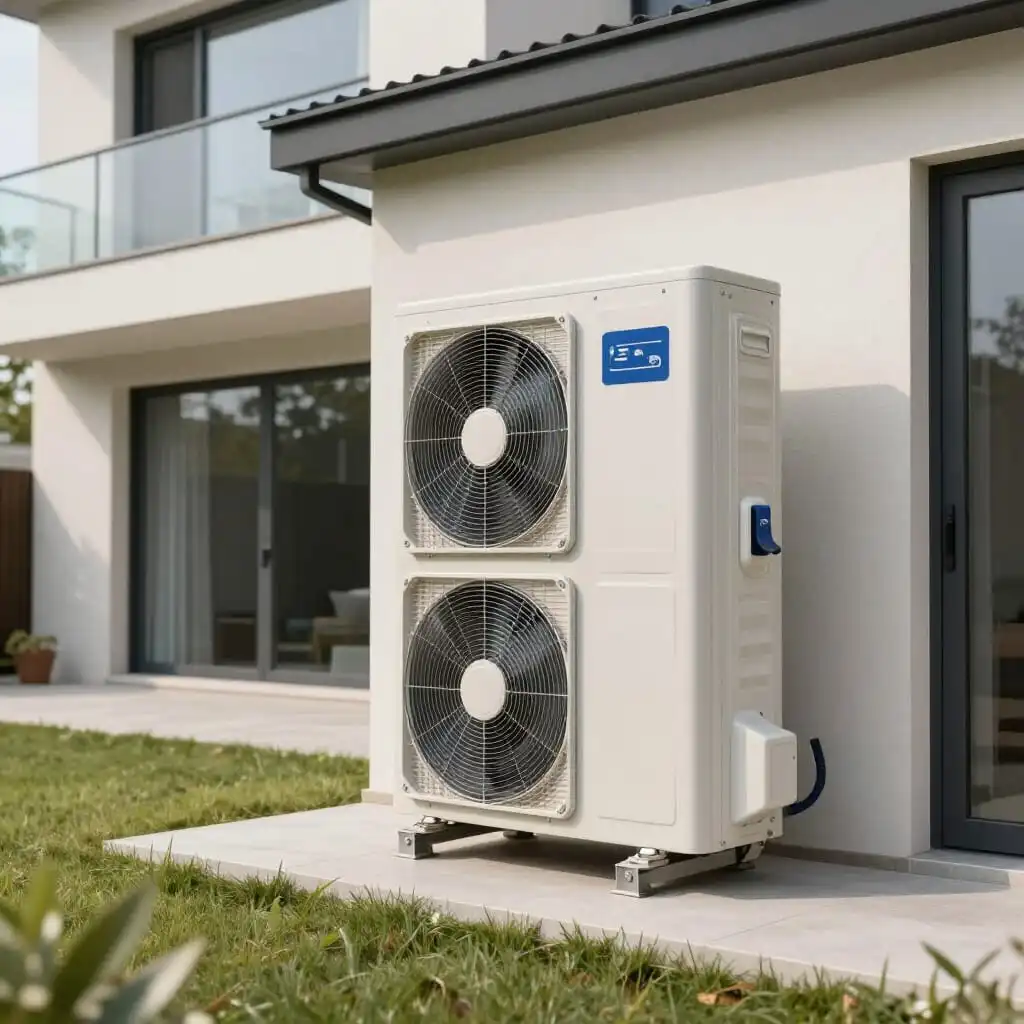
Air-source heat pumps extract heat from the outside air. These come in two versions: air-to-air, which distributes heat directly via indoor units (similar to a reversible air conditioner), and air-to-water, which feeds a central heating system (radiators or underfloor heating) and can also provide domestic hot water. This is the most common solution because it does not require extensive excavation work.
Ground-source heat pumps (water-to-water or ground-to-water) capture heat from the ground or groundwater via horizontal collectors or vertical probes. Their efficiency is more stable in winter, but installation requires drilling or excavation, making it the most expensive option upfront.
Hybrid heat pumps combine a heat pump with an existing gas boiler: the system automatically switches to the most economical source based on the outdoor temperature. This is an excellent transitional option for homes already equipped with a recent gas boiler, allowing you to upgrade your heating without a complete system overhaul.
The choice between these families depends less on personal preference and more on your home’s constraints: available space for ground collectors, the presence of a water-based radiator network, your budget, and your local climate.
Air-to-Air or Air-to-Water: The First Big Decision
For most households considering a heat pump, the decisive choice is between air-to-air and air-to-water, and it isn’t just about the price.
Air-to-air heat pumps heat the ambient air directly via wall units or ducted systems, much like a reversible air conditioning unit. They are simpler and faster to install, making them particularly suitable for homes without an existing central heating network, such as those using electric heaters. However, they do not produce domestic hot water and cannot feed into an existing underfloor heating system.
Air-to-water heat pumps integrate into a classic central heating circuit: they heat the water circulating through your radiators or underfloor heating and, depending on the model, can also provide the home’s hot water. While they require a higher initial investment, they are better suited for renovations where you want to keep your existing heating infrastructure.
The deciding factor is structural: if your home already has water radiators or underfloor heating, air-to-water is the natural choice to avoid duplicating your heat distribution system. Conversely, a home heated by electricity without a hydraulic circuit is more logically served by an air-to-air system, perhaps paired with a separate thermodynamic water heater for hot water. Some homeowners even opt for a mixed solution: an air-to-water heat pump for central heating coupled with a few air-to-air units in rooms that are poorly served by the main network.
Estimating Your Budget (After Subsidies)
The price of a heat pump varies widely depending on the type chosen, which is often the primary psychological barrier to getting started. For an air-to-air unit, budgets generally start around €4,200 for the device alone, while a complete geothermal system, including installation, can reach €25,000. In between, an air-to-water heat pump falls into a broad range, with prices excluding installation typically oscillating between €1,500 and €15,000 depending on the power and manufacturer.
On top of this, you must add installation costs, which generally represent between €2,000 and €5,000 depending on the complexity of the job—electrical connections, creating an exterior base, or adapting the existing hydraulic circuit. You should also budget for mandatory annual maintenance, which usually costs between €100 and €300 per year—a recurring expense that should not be overlooked when calculating long-term profitability.
This is where government grants come in, which can significantly change the financial equation. Incentives like MaPrimeRénov’, Energy Savings Certificates (CEE), zero-interest eco-loans, and reduced VAT can be combined (subject to income levels) and can cover up to €11,000 for an air-to-water unit, or even more when stacking multiple programs. The actual amount depends on household income, the type of heat pump installed, and the target energy performance—using an official simulator or getting a detailed quote from a certified professional remains the only way to get a reliable estimate for your specific situation.
Heat Pumps in Older Homes: Compatibility Check
Contrary to popular belief, the age of a building is not an automatic obstacle to installing a heat pump. It is the technical choices that make the difference, not the construction date of the house.
The first thing to consider is insulation. An old, poorly insulated house loses heat faster than it gains it, forcing the heat pump to run continuously at full power, which degrades its efficiency and increases your electricity bill. Before installing a heat pump in a house built between the 1960s and 1980s, for example, an energy performance audit and potential insulation work (for attics or walls) are highly recommended to ensure the equipment operates under optimal conditions.
The second point concerns your existing distribution system. Many older homes are equipped with radiators designed to run on high-temperature water (60-70°C), typical of a traditional oil or gas boiler. However, standard air-to-water heat pumps are most efficient at low temperatures (35-45°C). You then have two options: install a high-temperature heat pump, specifically designed for this scenario (though slightly less efficient than low-temperature models), or replace existing radiators with low-temperature models, which is an additional project to include in your total budget.
Finally, the electrical installation itself deserves a check: an outdated or undersized electrical panel may need upgrading to accommodate a heat pump, which can have a significant power draw during startup. Having these checks performed in advance by an RGE-certified professional avoids unpleasant surprises mid-project.
Disadvantages to Know Before Signing a Quote
No heating system is perfect, and the heat pump is no exception. Knowing the downsides in advance helps avoid disappointment once the unit is installed.
The initial cost remains the most frequently cited obstacle: even with subsidies, the upfront investment is much higher than that of a traditional boiler, and the return on investment is measured in years, not months.
Noise from the outdoor unit is a second point of vigilance, particularly for air-to-air and air-to-water models. The compressor and fan generate a noise level that, if not properly anticipated, can cause tension with neighbors in semi-detached or terraced housing. The placement of the outdoor unit, its distance from neighbors’ windows, and the choice of a silent model should be studied before purchase, not after installation.
Performance in extreme cold varies by model: some heat pumps see their efficiency drop significantly below -5°C to -7°C, requiring electric backup heating, the cost of which must be anticipated if you live in a region with cold winters.
Finally, mandatory maintenance—an annual check for devices containing more than 2kg of refrigerant—is a recurring requirement in terms of both cost and scheduling, which should be integrated into your operating budget from the start.
Steps to Take Before Installation
Starting a heat pump project shouldn’t be improvised; methodical preparation prevents the majority of the headaches encountered by homeowners.
The first step is to have a thermal study performed on your home. Often offered for free by reputable installers, this allows for the correct sizing of the unit based on surface area, insulation, and climate zone. An oversized heat pump costs more to buy and operates in short, inefficient cycles that wear it out prematurely; an undersized unit will struggle to heat the home during cold snaps.
Next comes the administrative side. Depending on your location, you may need to file a preliminary declaration of works (planning permission) with your local town hall, especially for the installation of an outdoor unit in protected zones or shared housing developments. It is better to verify this before signing a quote rather than once the work has begun.
You must also plan the location of the outdoor unit: minimum distance from property lines, sun exposure, accessibility for maintenance, and noise impact on neighbors are all criteria to validate with your installer in advance.
Finally, comparing multiple quotes from RGE-certified (Recognized Guarantor of the Environment) professionals remains your best protection against overpriced offers or shoddy installations. Obtaining three detailed quotes—comparing the proposed power, brand, warranties, and included maintenance services—allows you to make an objective choice, rather than one clouded by high-pressure sales tactics.
Choosing an RGE Installer: A Non-Negotiable Step
RGE certification is not just a simple administrative formality: it directly determines your access to government grants like MaPrimeRénov’ or CEE, and it proves that the craftsman has undergone specific training for installing this equipment.
Beyond the financial aspect, an RGE installer takes responsibility for the technical quality of the installation. This is a major factor for equipment whose performance depends heavily on precision: sizing the refrigerant circuit, ensuring leak-proof connections, and calibrating the controller. A poorly installed heat pump can perform far below its theoretical efficiency, regardless of the quality of the unit itself.
Before signing, it is recommended to verify the validity of the company’s RGE certificate, ask for references from similar projects (same type of house, same type of heat pump), and ensure the quote specifies the exact model, its power, manufacturer warranties, and the proposed maintenance contract. These simple checks are your best guarantee against the surprises that sometimes accompany such a significant investment.
What is the difference between an air-to-air and an air-to-water heat pump?
An air-to-air heat pump heats the ambient air directly via wall units, similar to a reversible air conditioner, without producing domestic hot water. An air-to-water heat pump feeds an existing central heating circuit (radiators, underfloor heating) and can also provide the home’s hot water.
Do heat pumps work well in older homes?
Yes, provided you check the home’s insulation and the type of existing radiators. A poorly insulated house reduces the heat pump’s efficiency, and radiators designed for high-temperature water often require a high-temperature heat pump or replacement.
How much does a heat pump actually cost including installation?
Budgets vary from approximately €4,200 for an air-to-air unit to €25,000 for a geothermal system, installation included. You should also add €2,000 to €5,000 in installation costs depending on the complexity, before deducting any available subsidies.
What financial aid is available for installing a heat pump?
Grants such as MaPrimeRénov’, Energy Savings Certificates (CEE), eco-loans, and reduced VAT can be combined depending on your income. The total amount can reach €11,000 to €16,000 depending on the household profile and the type of heat pump.
Are heat pumps noisy?
The outdoor unit generates noise from the compressor and fan, which can be an issue in shared or close-proximity housing if the location isn’t chosen carefully. Choosing a silent model and ensuring sufficient distance from neighbors’ windows can mitigate this.
Is it mandatory to use an RGE installer?
It is not legally mandatory to install a heat pump, but it is essential to benefit from government grants like MaPrimeRénov’ or CEE. This certification also guarantees that the craftsman has received specialized training for this equipment.
What kind of maintenance does a heat pump require?
An annual inspection is mandatory for devices containing more than 2kg of refrigerant. The cost of this maintenance is generally between €100 and €300 per year, depending on the type of heat pump and the service contract.
Are heat pumps efficient in extreme cold?
It depends on the model: some heat pumps see their efficiency drop significantly below -5°C to -7°C, requiring electric backup. Geothermal heat pumps, however, maintain more stable efficiency because ground temperature remains relatively constant.
Sources
- 2026 Heat Pump Installation Prices — Hellowatt
- Air-to-water or ground-source heat pump prices: what to expect? — ENGIE
- 2026 Air-to-Water Heat Pump Grants: The Complete Guide — HomeServe
- What grants are available for heat pump installation? — EDF
- Heat pumps in older homes — groupeibc.fr

D'autres conseils Energy-Efficient Renovation
 →
Electric Heating: Improve Performance & Save Energy
Learn how to optimize your electric heating: room-by-room control, maintenance, and smart home tech. Reduce your consumption by up to 25%.
Lire l'article → →
Energy Renovation: Comfort, Savings & Home Value
Discover how energy renovation improves comfort, reduces bills, and boosts property value through insulation, heating, and smart upgrades.
Lire l'article → →
Best Heating Systems for Renovation: 2026 Comparison
Choosing a heating system for your renovation? Compare heat pumps, gas, wood, and electric options in our 2026 guide with practical expert advice.
Lire l'article → →
Priority Home Renovation: Where to Start
Find the ideal order for home renovation projects. From insulation to safety and heating, follow our expert advice to prioritize effectively.
Lire l'article →